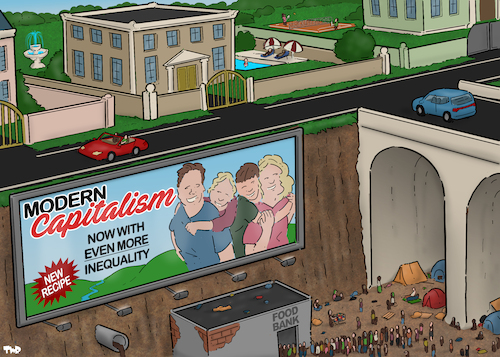
In the sprawling landscape of contemporary society, the perspectives of those who form its bedrock often remain obscured by layers of abstraction. Consider the modern truck driver, or “lorry driver” across the pond. For four decades, trucking has evolved from a simple occupation to a complex vantage point offering a uniquely intimate, albeit often overlooked, critique of modern capitalism. The trucker, caught within the ceaseless rhythm of highways and the shifting gears of a global economy, embodies a powerful metaphor for understanding the system itself – a system often perceived from afar, yet intimately experienced up close. Their perspective, emerging from necessity and routine, reveals a capitalism characterized as much by its raw, kinetic energy as by its intricate structures and consequences.
The Asphalt Altar: Enduring the Physical and Economic Strain
To the truck driver, modern capitalism is palpable in the form of the asphalt beneath their tires and the Herculean physical demands of their work. Driving long hours across vast distances subjects the body to a unique strain – the persistent rumble of the engine, the jarring of the road, the unrelenting focus required for safety. This physical toll is intrinsically linked to the very dynamics of the system. Efficiency demands schedules, fuel economy necessitates load consolidation and specific routes, and profitability often hinges on minimizing time on the road and maximizing miles, potentially bypassing rest requirements. The truck becomes more than a vehicle; it’s a mobile office, a dormitory, and a time capsule for the driver. Theirs is a life lived in two-liter bottles and a constant vigilance against fatigue, directly reflecting capitalism’s relentless pursuit of throughput and return on investment, even at the cost of elemental human comfort and well-being.
Invisible Threads: Navigating the Maze of Logistics and Information
Beneath the surface of physical endurance lies a world of invisible connections – a web of logistics and information unseen by most. Modern capitalism operates through global supply chains, complex orchestras of production, transportation, and retail orchestrated by invisible algorithms and digital platforms. The truck driver, navigating GPS systems, constantly receiving electronic waybills, and communicating via satellite phone, is, paradoxically, one of the few visible links in this intricate web. They are the humble messenger, translating the digital plans of a warehouse manager into the physical movement of goods across continents. Delays caused by digital routing errors or logistical breakdowns elsewhere reverberate through the system, slowing the flow of merchandise from the factory to the consumer’s doorstep. This precarious existence, dependent on the seamless functioning of a system largely managed by others, highlights the fragility within the apparent solidity of global commerce. The trucker experiences the gap between digital planning and tangible reality.
The Highways of Debt: The Enduring Grip of the Gig Economy?
The economic calculus faced by truck drivers represents one of the most telling aspects of modern capitalism’s shift towards precarious labor. While many drivers are still employed under traditional contracts, the shadow of the gig economy looms large. The constant need for capital is acute – for truck payments, insurance, repairs, fuel, and the often substantial down payment for the vehicle itself. This fosters a unique dynamic where drivers feel pressured to maximize deliveries, sometimes at the expense of safety or rest, reflecting the high-stakes environment of an industry increasingly shaped by performance metrics and shareholder value. The pursuit of maximum utilization, dictated by corporate targets or even personal financial necessity, can lead drivers down a familiar path towards burnout and risk. It’s a reflection of a system that often measures success in quarterly earnings, not necessarily in the long-term health of its workforce, echoing the pressures faced by other precarious workers in what economist Guy Standing perhaps termed a “precaritized” labor market.
The Merciless Marketplace: Consumerism on the Move
The truck driver is a unique and mobile conduit connecting the assembly lines of production with the consumer endpoints of a voracious market. They are privy to the constant, tangible flow of goods that fuel the engine of consumer capitalism – from specialized agricultural commodities to mass-produced electronics, from standardized components to fashion trends shipped from regional centers. Their perspective offers a ground-level view of the relentless churn: the just-in-time demands from distribution centers, the pressure to move sensitive goods in specific temperature ranges, the sheer volume involved in meeting even fractionally small increases in demand. This constant motion places them directly in the vortex of “late modern hyper-globalized” capitalism, arguably the most consumer-centric phase yet, acting as the tireless, anonymous shogun facilitating the ever-expanding engine of consumption.
E pluribus unum: Hyper-globalization and National Interests
The truck driver’s route often bisects borders, navigating complex networks of global supply chains that owe little to traditional national manufacturing strengths. Modern capitalism, in its contemporary phase, is often characterized by hyper-globalization – the erosion of the nation-state’s economic primacy as capital and goods flow freely across borders. The driver experiences this not just in the physical act of crossing borders, but in the fundamental reorganization of production and consumption. Goods are sourced globally based on lowest operational costs, irrespective of origin, further blurring traditional national economic identities. This relentless homogenization of the world marketplace, facilitated by the truck driver’s tireless efforts, underscores the forces driving globalization, even as it creates points of friction (like paperwork delays at ports of entry, border crossings themselves being mini-diasporas of capitalism). The trucker embodies the atomized individual within this global network, contributing to the creation of a truly borderless, anonymous world of work and commerce.
A Different Scale: The Rise of Finance and the Tangible
While the digital revolution fuels much of contemporary capitalism, pushing transactions into instantaneous online spaces and creating vast, abstract asset classes inaccessible to most, the truck driver remains firmly rooted in the physical, touch-and-verify world. Theirs is a life dominated by the tangible – the weight of the load, the state of the vehicle’s chassis, the physical condition of its cargo upon arrival. This grounding in the physical contrasts sharply with the often-dehumanizing and wildly speculative world of pure finance that increasingly shapes the economy. The driver, focused on the immediate, physical consequences of decisions made far away in boardrooms with potentially complex, opaque ownership structures, offers a vital counterpoint. Every delay, every damaged shipment, every breakdown is a tangible consequence, reminding them (and via them, perhaps) of the world they navigate – one built on real assets and concrete realities, even as its direction is increasingly dictated by intricate, abstract financial mechanisms.
Conclusion: The Unsung Cartographer of Capitalism
The truck driver’s view of modern capitalism offers a unique and indispensable perspective. It’s a perspective emerging from physical endurance, navigating complex logistical networks and the anxieties of debt. It’s a view conditioned by the relentless pace driven by consumer demands and hyper-globalization, yet simultaneously tethered to the undeniable reality of the physical, tangible world. They operate, almost invisibly, within the immense, impersonal system, transforming raw materials into delivered goods and time into bytes dictated by corporate servers. In the vast, often chaotic journey of a modern capitalist system – its triumphs and tribulations, its efficiencies and its human cost – the truck driver stands as a vital, unsung node, charting the course through the kinetic, gritty reality that underpins the invisible engines of global wealth.


