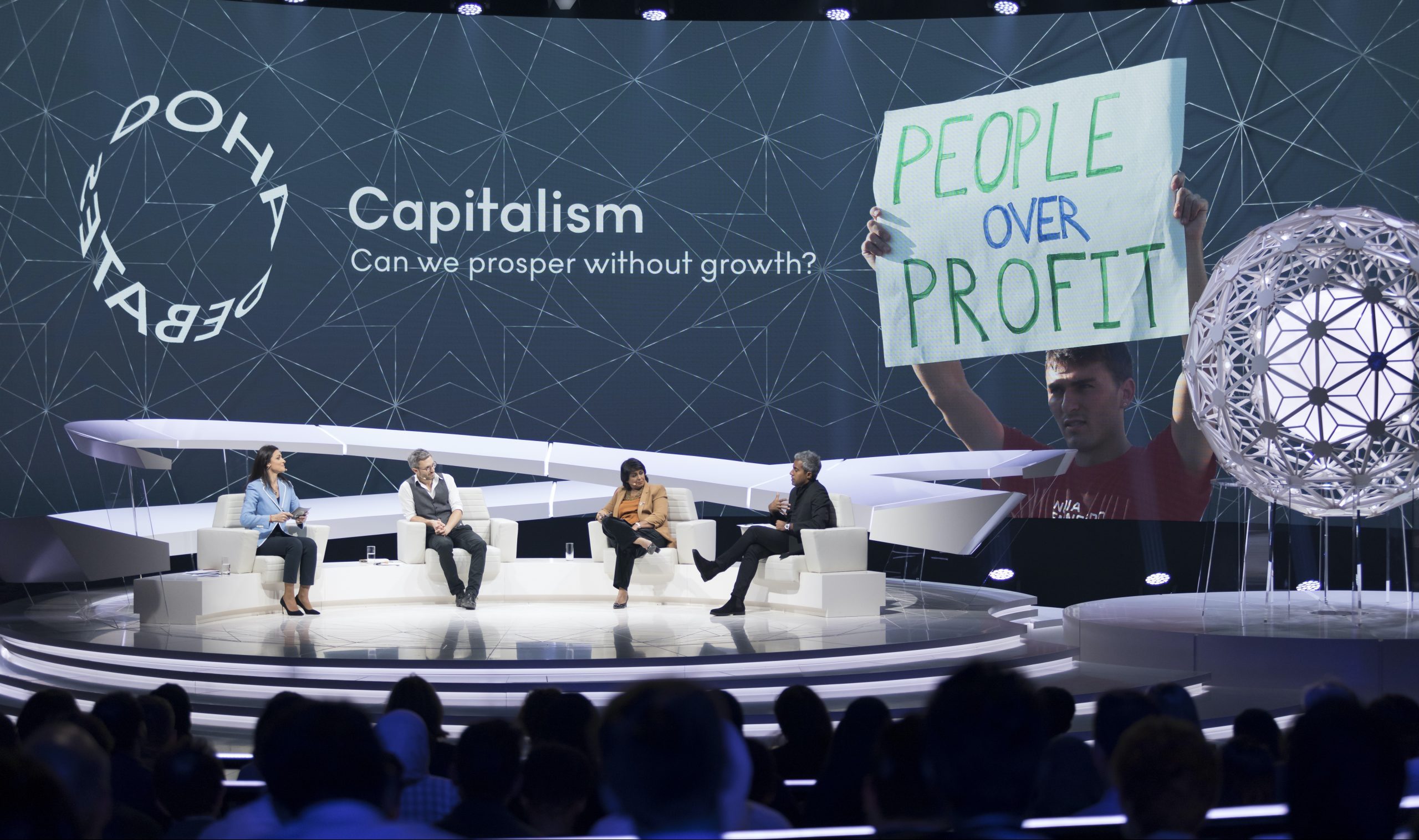
The recent “Capitalism Debate” referenced in the data naturally brings us to examine the often perplexing and contradictory relationship between a global economic system and one of humanity’s most discussed, and often maligned, traits: greed. As we dissect the arguments surrounding this system, a consistent theme emerges—capitalism, in its various forms, dances intimately with the concept of unbridled desire. It is perhaps one of the most peculiar aspects of this complex system: how greed, typically associated with vice, has somehow been co-opted, even if implicitly, as a kind of virtue within the discourse of unfettered free markets. But why is this duality so captivating? Why do we remain enthralled, even intellectually wrestling with the implications?
The Defining Double-Edged Sword
Capitalism, at its core, is predicated on the principle of the spontaneous order—systems that arise without central directive, guided instead by individual actions and interactions. Adam Smith’s The Wealth of Nations famously described how seemingly self-interested economic actors, when free to pursue their own gain, could paradoxically lead society toward greater prosperity through the invisible hand of the market. This inherent connection between individual economic pursuit and societal benefit is one of capitalism’s most powerful, yet most enigmatic, attributes. It suggests that the relentless drive, which society often labels greed, possesses a remarkable capacity for positive externalities. Yet, this same drive, left unchecked, can also manifest as destructive hoarding, wasteful speculation, and immense inequality—outcomes that seem antithetical to social harmony.
Greed as the Engine of Motion
It is impossible to fully grasp modern economic development without acknowledging the role of desire, or *cupiditas*. From the quest for wealth that funded the Renaissance and exploration, to the industrial revolution powered by ambition, to the digital transformation driven by consumer wants, history is replete with examples where perceived greed spurred innovation and progress. Thomas Hobbes, in contrast, saw humanity primarily driven by competition and covetousness, viewing it as potentially destructive. However, within the capitalist framework, the same engine of desire allows businesses to emerge, goods to be produced beyond mere subsistence, and services to proliferate. This engine provides the essential *impetus* for economic activity. Without it, even Friedman’s argument about maximizing shareholder value becomes sterile, unless value creation itself is somehow divorced from value desire. The pursuit is the prerequisite, a paradoxical virtue that simultaneously drives and troubles the system.
Psychological Drivers: The Allure of Acquisition
Why is this pursuit so compelling? On a psychological level, the desire for acquisition taps into ancient survival mechanisms. Possessions are proxies for security, status, and power. Neuroeconomics suggests that dopamine release during reward anticipation plays a significant role, linking economic gain to tangible pleasure responses. Beyond basic needs, humans covet social standing, exclusive goods, and the security that accrues with wealth. Daniel Kahneman’s work on behavioral economics highlights cognitive biases that can distort our perception of value and the consequences of acquiring or accumulating. However, the core attraction remains, intertwined with narratives of ambition overcoming hardship and the achievement derived from mastery and economic success. This narrative—pioneered perhaps by early proponents of capitalism who championed self-interest—resonates, embedding greed within the very fabric of success narratives, creating a potent, albeit tarnished, virtue.
Cultural and Rhetorical Manifestations
The public fascination often manifests not only in economic discussions but also in cultural narratives. Characters in literature from Avarice in early morality plays to modern Wall Street figures occupy complex roles in societal storytelling. Rabelais caricatured greed long before Adam Smith wrote systematically about its economic benefits. Yet, over centuries, it appears that capitalism, more than perhaps other systems, demands continuous justification. This constant defense, this effort to align a seemingly destructive motive with positive outcomes, inherently requires acknowledgment. Political rhetoric often oscillates: the necessity of incentivizing greed is championed when markets falter, while pleas for regulation appeal to empathy and shared scarcity when market success appears disproportionate. These public struggles hint at the deep-seated confusion around the term and its relationship to the system, suggesting that “greed” remains a compelling, if ambiguous, element.
Functional Necessity versus Dysfunctional Excess
The enduring question, therefore, is whether capitalism has successfully integrated the drive, labeling it a necessary motivator (“greed is good,” famously argued in the film *Wall Street*), or if the system relies on the populace buying this justification. Capitalism functions, at least partially, because individuals are motivated by perceived gain. The system encourages competition, efficiency, and innovation, ostensibly leveraging this “virtue.” Yet, a purely unregulated, infinitely greedy system faces inherent flaws: it can lead to boom and bust cycles fueled by irrational exuberance, it ignores externalities and creates inequality often perceived as corrosive to social cohesion, and it potentially incentivizes short-term thinking detrimental to long-term societal well-being. The “virtue” might be an emergent feature for *sustained* system function, but the underlying drive, untempered by empathy or constraint beyond profit, remains fundamentally flawed. The debate surrounding the system often hinges on whether these deep-seated motivations are inherently redeemable or simply necessary for its survival, creating a persistent tension between functional necessity and normative critique.
A Fascination Carved by Contradiction
Ultimately, the power of the “capitalism and greed” debate lies in its inherent contradictions. Capitalism requires the relentless pursuit, yet cannot fully endorse it. Society both cultivates and condemns this drive. It is a virtuous force enabling progress but also a vice threatening collapse under the weight of individualism. The enduring public interest stems from grappling with this duality: the seductive power of accumulation versus the societal need for solidarity, the productive energy of desire versus the damaging nature of inequality and shortsightedness. The system’s uncanny ability to harness contradiction itself fuels the ongoing fascination, making the discourse around greed a perennial, unresolved, and deeply fascinating one.


