Capitalism’s Blind Spot: Externalized Costs
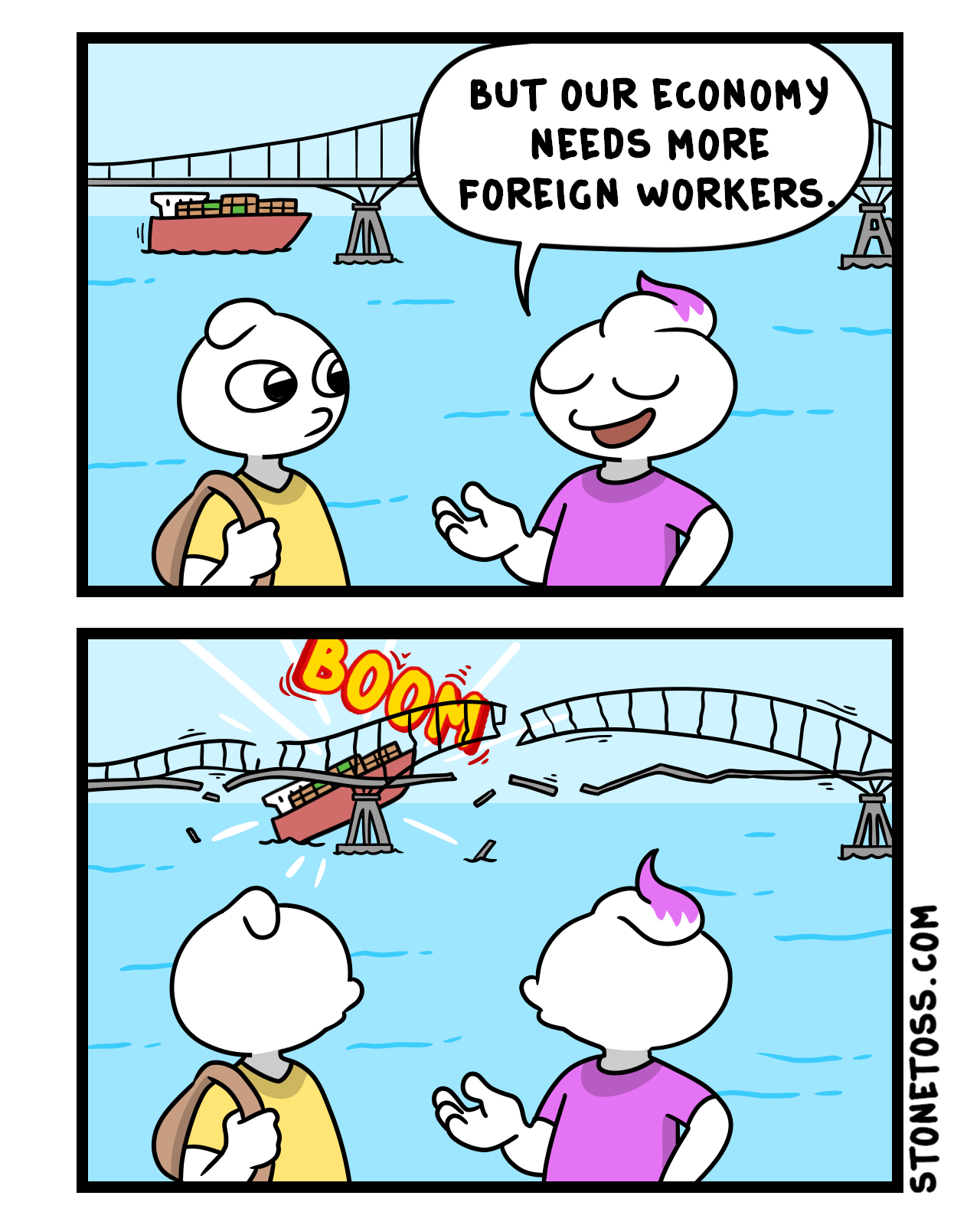
The morning of March 27th, 2“202”, became a stark, horrifying tableau. A 5.0 magnitude aftershock struck not far from the crumbled remains of the Francis Scott Key Bridge, a vital artery spanning the Patapsco River in Baltimore. What unfolded in the preceding days was not merely an engineering collapse or a victim count; it was a brutal, real-time illustration of profound systemic failure. For years, the bridge was deemed “structurally deficient.” Its maintenance and repair were shuffled sideways, onto the ledger somewhere else, ignored, deferred, until gravity – and water – became inescapable.
The All-Encompassing Principle of Profit
Let us dissect the engine driving this kind of systemic neglect. At the heart of most modern enterprises lies an insatiable drive: the maximization of profit. This is not inherently evil; capital accumulation has fueled innovation and growth throughout history. Yet, the relentless pursuit of profit creates its own gravitational pull, attracting resources away from long-term thinking and forcing certain costs underground.
Enterprises meticulously track and account for so-called “accounted costs.” These are the tangible, easily quantifiable expenses: wages, raw materials, rent, interest. The rest – the anticipated lifespan of assets, the true cost of debt over time, the ecological footprint generated by operations – often resides in the shadow economy of the business, rarely reflected directly on the profit and loss statement.
This phenomenon, the internalization of accounting, is crucial. Investors respond to quarterly returns. Boardrooms measure success by market share and immediate profit margins. The language of business is numbers, and the numbers that scream at the top of charts are the ones that appear on the income statement. Anything externalized, anything that doesn’t hit that ledger, becomes effectively “invisible.”
Ecological Time Scales Mismatched Against Corporate Lifespans
One of the most telling features of the K&G pipeline tragedy is the sheer temporal disconnect between ecological processes and corporate investment horizons. Plants grow over decades; ecosystems form over millennia. Pipelines, in contrast, are supposed to last decades, *if* properly maintained. The decision to invest in extraction or transportation infrastructure is predicated on short-to-medium-term value generation, typically aligned with debt covenants and regulatory approval cycles.
But the true cost of digging beneath a river, laying pipes hundreds of feet underground, involves assessing conditions – geological, hydrological, biological – that are constantly shifting on scales vastly longer than the operational lifespan of the asset itself. This is a problem of methodology. Economists typically measure costs against immediate returns. Ecology, however, operates on vastly different time scales. We discount future liabilities so heavily (or technically remove them entirely from the immediate financial picture) that their significance fades.
The consequences are profound. Infrastructure designed without contemplating the full lifecycle impact on land and its inhabitants carries an implicit cost that remains uncalculated until disaster strikes, or decays slowly on our environment, its cost spread over decades or centuries. This is a fundamental threshold economics issue – we fail to build the financial models that adequately quantify these long-term threats.
The Weight of the Human Ledger
The scope of externalized costs extends far beyond the physical world. Consider the countless “social costs” that remain unaccounted for. This includes the differential valuation of labor – particularly the underpayment and dehumanization of work deemed “unskilled,” essential yet low-waged, such as warehouse picking, poultry processing, or delivery driving. Consider the environmental racism embedded in polluting industries选址 often near marginalized communities.
In these instances, we are not just externalizing financial costs; we are externalizing human well-being. The true cost of cheap production – whether it’s emissions, resource depletion, unsafe working conditions, or poisoned communities – doesn’t land in the company’s bottom line or in government budgets. Its consequence is distributed unevenly across society, bleeding into public health systems, demanding future environmental justice, and undermining collective equity. This invisible weight is staggering.
And what about the erosion of our own cognitive and civic well-being? Is the externalized cost of constant news cycle chaos, the degradation of community spaces, or the psychic toll of relentless competition accounted for in corporate strategy? It’s less tangible, harder to assign a price tag, yet no less profound as a drain on societal and personal health.
The Corporate Conundrum: Gains vs Sustained Value
This is the quintessential corporate conundrum. Markets reward short-term value creation. Yet, companies that truly wish for long-term survival must grapple with the reality that ignoring externalized costs is self-destructive. The internalization within company balance sheets, the focus on quarterly earnings, actively incentivizes leaders to defer addressing the true costs of their operations.
This isn’t malice, it’s often a matter of conflicting incentives and insufficiently forward-looking frameworks. Without a way to accurately measure the risks of environmental degradation or the costs of reputational damage stemming from neglect, the default is towards short-termism. The very structure of financial markets can favor the skittish investor who wants certainty today, rather than the patient stakeholder who requires investment in tomorrow.
This is not a crisis confined to infrastructure or manufacturing. It touches every corner: tech companies outsourcing production to nations with lax regulations or disregarding data privacy, financial institutions funding fossil fuel extraction despite climate threats, even extractive thinking within content creation itself, chasing fleeting viral success rather than building enduring value.
The Toll Not Accounted For: More Than Just Dollars
When we refer to “externalized costs,” we must be careful about our semantic distinctions. Sometimes, costs can be accounted for but remain obscured – not explicitly listed on an P&L, but factored into strategic decisions or overhead allocation (like research on polluting alternatives that doesn’t pay off immediately). Externalized costs are typically those that are *entirely absent* from the financial calculation.
The unaccounted toll means they don’t just disappear; they manifest. They become physical failures, environmental disasters, market saturation, loss of stakeholder trust, erosion of regulatory goodwill, and much more. It’s the difference between managing resources responsibly (an accounting practice), and ignoring the long-term viability of operations entirely.
The Vicious Cycle of Cost Avoidance
There’s a seemingly inescapable logic to this. Companies avoid the *investments* required to address externalized costs – preventative maintenance, sustainable sourcing, adequate safety training – precisely because those investments don’t reduce the *accounted cost* for shareholders in the short term. Instead, they require significant upfront expenditure.
This creates a downward spiral for the truly forward-thinking company, paradoxically. Addressing the problem of externalized costs *does* necessitate costly rethinking. But the companies that lead this charge risk short-term financial pain, sometimes leading to market rejection or investor flight. They may become outliers seen as inefficient, lacking the ruthless efficiency that stock markets reward at least in the moment. This can isolate a company, making it less competitive precisely because it plays the long game – almost the antithesis of “stone age thinking.”
Pining for Perspective: The Cognitive Leap
It boils down, in part, to perspective. The engineer designing the pipeline didn’t look twenty meters deep and ask, “What happens if the seabed fails twenty years down the line?” The investor didn’t consider the potential multi-billion dollar liability of a collapsed bridge crippling commerce and regional transport hubs. The executives pushing the project through prioritized the visible, measurable gains of securing a contract, perhaps meeting short-term profit targets.
This isn’t purely about information gaps, although those certainly exist. It’s deeper; it’s a question of prioritization and the framing of decisions. We need a cognitive shift, a way to evaluate risks that aren’t immediately pressing or easily attributable to a current activity. This requires organizational readiness to consider complex scenarios where the probability of failure might be low but the consequences if avoided are enormous.
We might even posit a form of business-world Heisenberg uncertainty principle: attempting to isolate and measure “externalized costs” precisely might actually change the system being measured, demanding a radical redefinition of risk itself.
Thresholds: The Unseen Line Where Systems Shift
The concept of externalized costs gains profound importance when viewed through the lens of **Threshold Economics**. This isn’t about assigning a precise dollar value to intangibles, but rather understanding the existence of critical points (thresholds or tipping points) beyond which systems change dramatically.
Whether it’s a market reaching saturation, ecological systems collapsing, or infrastructure becoming structurally unsound, there’s often a crossing of a threshold. The traditional profit-driven model, focused on marginal efficiency, struggles to capture these systemic shifts until they erupt into crisis. Externalized costs represent the slow accumulation of risk that, once the threshold is crossed, represents a cost so immense it dwarfs all previous accounting.
Moving Towards Sustainability: More Than a Trend
The term “sustainable” became ubiquitous in business lexicon, often used as a buzzword. But true sustainability requires more than marketing-speak or voluntary adoption; it requires embedding what are currently externalized costs into core value creation models.
This means rethinking capitalism itself. It requires financial systems that better reflect long-term value and inherent systemic risks. It demands product-centricity, where the obsolescence of an externalized cost investment is designed into the product lifecycle from the start, rather than being treated as a footnote. It necessitates a shift from zero-sum competitive paradigms towards collaborative approaches where shared value replaces pure cost minimization.
A Moral Imperative Disguised as Profit Potential
In an age of AI-generated content and rapid obsolescence, one might wonder: does the very structure of a system incentivize obsolescence, favoring that which is cheap and disposable? Is this the “stone age thinking” referenced? Perhaps, in the way we cling to familiar tools despite knowing that sustainability demands different ones.
Maybe the imperative to address externalized costs isn’t just an economic calculus or a practical necessity, but a moral one. By failing to account for the ecological and social toll of our actions, are we betraying ourselves and future generations? We are playing God with planetary resources under a veil of financial opacity. This requires a shift from shareholder primacy to stakeholder capitalism, recognizing that long-term viability hinges on trust, not just profit.
Re-calibrating Humanity: The Endgame
Ultimately, capitalizing on externalized costs is a dangerous game, the high-stakes gamble of the uncalculatable. The Francis Scott Key Bridge tragedy serves as a somber bell toll for us all – a reminder that we are measuring a system using tools ill-suited for its complexity.
True value isn’t just financial; it encompasses ecological integrity, social stability, and cognitive serenity. The blind spot isn’t in acknowledging costs, but in acknowledging *all* costs. The challenge lies in developing the tools, frameworks, and narrative languages – the new “stone age tools” – to integrate these invisible, yet profound, elements into the center of how our economic and social systems operate. It demands a fundamental re-calibration, perhaps not of the profit imperative itself, but of its scope, its horizons, and its consequences.

