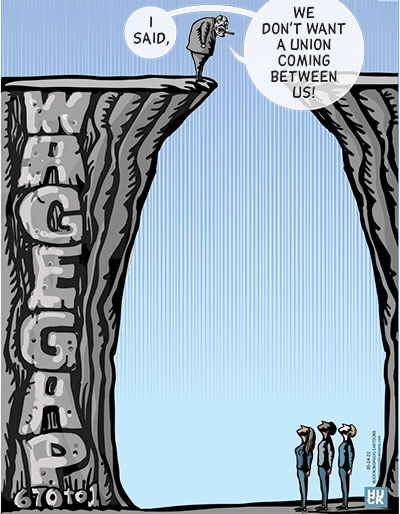
Imagine a stage, brightly lit, the center of economic activity. And upon this stage, capitalism has performed countless plays. Success, innovation, competition – it sells these narratives. But sometimes, a subtlety unfolds, less dramatic but more insidious: the persistent wedge between worker compensation and corporate profit. It feels almost cunning, the way market logic can be skewed to favor certain outcomes. Could this “favoring” mechanism be capitalism’s favorite tactical advantage, playing out in the familiar guise of the wage gap? Let’s peel back the curtain.
Defining the Deceit: Beyond a Simple Misstep
First, let’s clarify the term – the “gap” isn’t one single, undifferentiated thing. Historically, the gap refers largely to income inequality – the disparity between the wealthiest individuals and corporations and the median, or even average, worker. Think widening chasms in wealth distribution, a phenomenon economists often call distributive conflict. It’s not just that pay isn’t keeping up with output or value; it’s the structural skewing of where that increase goes. Market forces exist to distribute economic gains, but in the grand theater of capitalism, the distribution is often anything but meritocratic or organic.
Historical Echoes: A Tremor from the Past
The roots of this aren’t hibernating secrets, but active forces in the present economy. While the wage gap discourse often pivots to gender, the economic logic driving the gap has older, deeper narratives. Adam Smith, in his Wealth of Nations, observed the divergence between fair wages for labor and the concentrated profits sought by capital. This isn’t a modern aberration. The concentration of wealth and power over time allows actors – investors, executives – to exert disproportionate influence on market valuations, often decoupling executive remuneration (or asset appreciation) from frontline pay increments, despite the interconnected nature of operations.
The Architecture of Advantage: Mechanisms of Skew
Capitalism provides the mechanisms, but the actors often manipulate its inherent tendencies. Consider the classic rent-seeking behavior. This occurs when individuals or groups legally or semi-legally gain favor (e.g., market dominance through lobbying, capturing regulatory processes, securing artificial market monopolies). These positions allow a return “derived not from creating value but from controlling its distribution.” Think large established corporations with regulatory capture or industries benefiting from specific subsidies. They gain market share or privileges, increasing their net worth listed on balance sheets, while the base-level wage bill for their operations may stagnate. It plays on the rules of the market to distort outcomes.
Furthermore, we operate within a system that often favors ownership and control. This isn’t just about CEOs wanting sky-high salaries (though that certainly exacerbates the gap); it’s about the fundamental alignment between economic success and control. As philosopher Karl W. Giberson might allude, the system often rewards those already ahead, reinforcing inequalities through compound effects. Access to capital, information, networks – these aren’t always freely available, creating and perpetuating divides. Investment in technological advantage, political influence, or leveraging existing networks provides an unevenly competitive playing field where the initial disparity breeds further advantage.
The Gendered Narrative: Intersectionality of Exploitation
Naturally, the discussion cannot be complete without addressing the gendered dimension, a layer added onto a pre-existing structure. The wage gap, in many analyses, refers specifically to the phenomenon where women earn less than men for comparable work. The complexity here defies simple attribution. While capitalism doesn’t inherently dictate gender pay discrimination, the intersection of historical power imbalances, societal expectations, and market dynamics can amplify the gap beyond the pure distributive conflict.
Consider the factors like occupational segregation (women often concentrated in lower-paying sectors), wage negotiation dynamics (historically undervaluing roles often associated with women), the impact of unpaid care work predominantly shouldered by women, and systemic barriers to advancement for women, particularly women of color. These aren’t new struggles directly invented by pure market forces, but inequalities exacerbated within a capitalist framework because capitalism rewards productivity, and historical burdens (like caregiving) disproportionately impact female productivity, altering the supply-demand curve (or lack thereof) for certain female labor segments.
Globally Uneven: The Modern Battlefield
The wage gap isn’t a static line in the sand; it shifts geographically and across industries, making it a truly global issue. While multinational corporations dictate certain standards (often reflecting their headquarters’ economic realities), the gap manifests unevenly. Workers in emerging economies may earn meager wages relative to global market valuations of their companies’ intellectual property or natural resources. In advanced economies, the gap may be more about the disparity between high-skill and low-skill wage segments within the domestic market, influenced by automation, global sourcing, or simply market volatility.
The digital transformation adds further dimensions. The “digital divide” isn’t just about access to technology; it’s an economic gap reflecting differential investment in skills needed for new high-productivity roles. Access to capital for entrepreneurship is uneven, creating disparities in how businesses scale their value, impacting wages across the board. These aren’t isolated stories; they feed back into the broader dynamic of market allocation favoring certain actors and paths over others.
The Technological Tightrope: Productivity vs. Displacement
Technology is presented as a driving force of capitalism’s dynamism, boosting productivity and unlocking innovation. The argument is often that as productivity increases, wages should rise for all – that efficiency gains translate directly into worker compensation. History, however, offers a counterpoint. Often, productivity increases, particularly automation-driven ones, lead to a decline in demand for certain labor segments, driving down wages for those tasks, while the costs and profits of technology implementation disproportionately accrue to management and ownership. This is sometimes termed the “capital-labor substitution,” where companies substitute technology (a capital investment) for human labor.
The gains from increased productivity are often captured not by broad-based wage hikes for a company’s workforce, but by increased investor returns (shareholder value), reduced operating costs, or even, sometimes, higher executive bonuses tied to overall performance metrics. This creates a scenario where worker productivity grows, but the distribution favors capital over labor in ways that widen the gap between worker pay and the overall value generated.
Beyond the Numbers: Aspirations for Redefining Favor
The question remains: how do we, within these capitalist parameters, address the gap without fundamentally restructuring power? It requires a willingness to challenge the unspoken bias towards capital accumulation over worker welfare, challenging the assumption that market efficiency equals equity. Perhaps it involves more robust social safety nets and progressive taxation to redistribute wealth upwards (reducing inequality). Or strengthening collective bargaining to ensure fairer distribution of productivity gains. Investing in education and reskilling programs acknowledges the need to address underlying skills mismatches but must be coupled with fair wage policies.
Regulation may need to step in more proactively: tackling issues of unfair competition (rent-seeking), ensuring transparency in executive compensation tied more logically to worker productivity and well-being (not just sales or stock performance), and perhaps challenging patent systems that allow monopolies to inflate profits at worker expense.
Ultimately, the notion of the wage gap invites scrutiny of what “favoring” in the economic system actually means. As we navigate towards a more prosperous and equitable future, understanding this gap, not as a mere statistical artifact, but as a reflection of complex incentives, power structures, and historical forces within capitalism, becomes crucial. Unveiling this favorite trick requires more than economic analysis; it demands a thoughtful reorientation of values. The stage is set. The lines are drawn. What direction will the play take?

