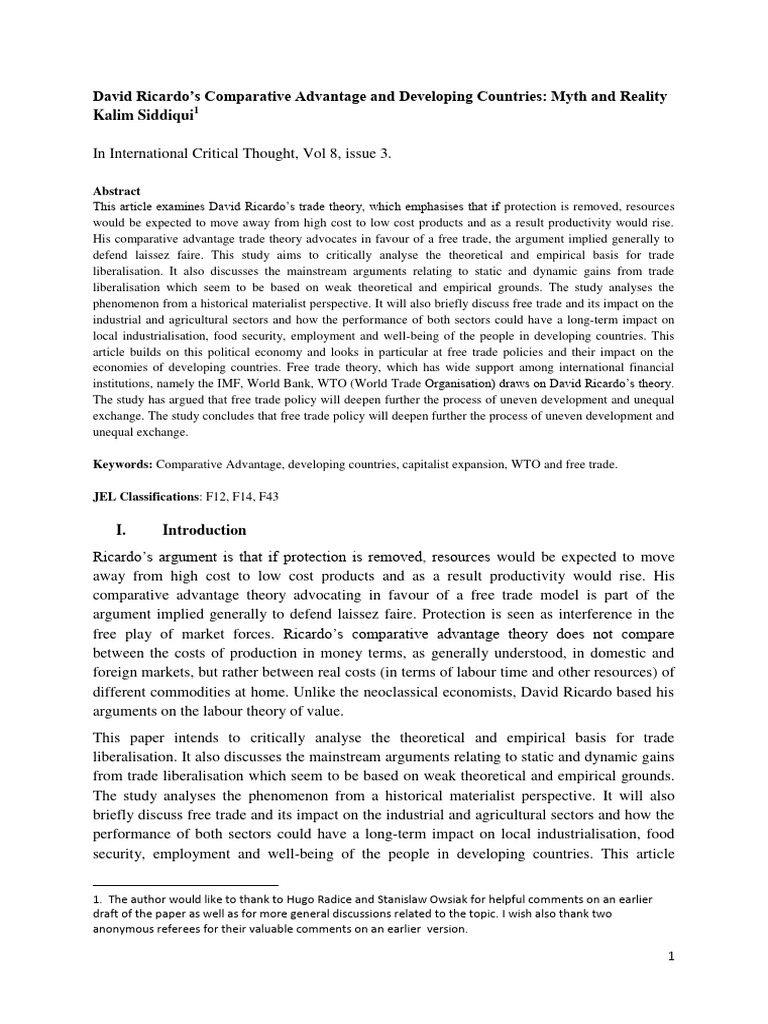
In the ever-evolving landscape of global trade and economics, the principles laid down by David Ricardo in the early 19th century continue to resonate powerfully. His theory of comparative advantage not only revolutionized economic thought in his time but remains a cornerstone for understanding the benefits of international trade today. This theory explicates why nations engage in trade and how they can maximize efficiency and wealth even when one country is more productive in all goods than another. Exploring the various facets of Ricardo’s comparative advantage offers a rich perspective on its enduring significance and applicability in the contemporary economic environment.
The Foundations of Comparative Advantage
At the core of Ricardo’s theory lies a simple yet profound insight: countries should specialize in producing goods for which they have a relative efficiency advantage, even if they are absolutely less efficient in producing all goods compared to another country. This principle hinges on opportunity cost — the cost of forgoing the production of one good in order to produce another. By focusing resources where opportunity costs are lowest, countries achieve greater overall efficiency.
Ricardo’s model dispensed with the mercantilist dogma of accumulating wealth by hoarding gold or maximizing exports blindly. Instead, it rationalized the mutual benefits of trade grounded in comparative rather than absolute advantages. This paradigm shift laid the groundwork for understanding why even less-developed or less technologically advanced nations find gainful participation in the global market.
How Comparative Advantage Shapes Modern Trade Policies
In the present-day global economy, Ricardo’s theory remains deeply embedded in trade policies, international agreements, and economic strategies governments employ. Countries assess their comparative strengths in sectors such as agriculture, manufacturing, technology, or services to determine competitive positioning. This informs tariff impositions, free trade agreements, and strategic alliances.
The theory’s influence is evident in multilateral organizations that promote trade liberalization, such as the World Trade Organization. It supports the advocacy against protectionism by demonstrating that when nations specialize based on their comparative advantages, the global community benefits through increased aggregate production, lower prices for consumers, and more diverse access to goods and services. Policy debates continue to refer back to this foundational framework when evaluating the costs and benefits of trade protections or subsidies.
Comparative Advantage and Technological Advancement
The dynamism of comparative advantage is further enriched by technological innovation. Unlike the static world of Ricardo’s time, today’s economies experience rapid technological shifts that continually redefine comparative advantages. Countries once reliant on low-wage manufacturing may pivot toward technology-intensive industries or services, altering global supply chains and trade patterns.
Moreover, technology can influence comparative advantage by reducing opportunity costs or expanding productive capacity. Automation, artificial intelligence, and digital platforms have the potential to enhance efficiency dramatically. However, they also introduce complexity, as nations must recalibrate their specializations in response to evolving technological landscapes. This underscores the enduring relevance of comparative advantage not as a fixed assignment but as a fluid and adaptive economic principle.
The Role of Comparative Advantage in Developing Economies
For developing nations, comparative advantage offers a pragmatic pathway to economic growth and integration with global markets. By identifying sectors where they hold relative efficiencies—be it in natural resources, low-cost labor, or niche agricultural products—these countries can harness trade as a catalyst for development.
Nonetheless, challenges abound in realizing these advantages. Infrastructure deficits, skill shortages, and geopolitical hurdles can impede the full exploitation of comparative strengths. Furthermore, reliance on narrow comparative advantages, such as commodity exports, may breed economic vulnerability. Diversification and gradual upgrading of capabilities remain critical strategies to move beyond rudimentary advantages toward higher value-added industries.
Critiques and Misconceptions Surrounding Comparative Advantage
Though widely accepted, the concept of comparative advantage is not without its critics and complexities. One common misconception is that comparative advantage advocates for unrestricted free trade regardless of social or environmental consequences. In reality, the theory deals primarily with efficiency and resource allocation rather than distributional effects or externalities.
Critics highlight scenarios where trade based on comparative advantage can lead to deindustrialization in some sectors, cause job displacements, or exacerbate inequality within countries. These outcomes call for nuanced application of comparative advantage principles, incorporating complementary policies such as social safety nets, retraining programs, and environmental regulations to ensure equitable and sustainable trade benefits.
Comparative Advantage in the Age of Global Supply Chains
Global supply chains have transformed the way comparative advantage manifests in trade. Rather than entire finished goods being produced in a single country, production processes are now fragmented across multiple nations, each contributing specialized tasks based on comparative advantage at a granular level.
This disaggregation amplifies the gains from trade but also complicates the landscape. Factors such as geopolitical tensions, trade disruptions, and transportation costs influence how comparative advantages are leveraged. Companies and governments alike must adjust strategies to optimize these supply chains, balancing efficiency with resilience.
The interplay between multinational corporations and national economic policies underscores a modern dimension where comparative advantage extends beyond countries to include firms and regions within countries, reflecting a more intricate economic mosaic.
The Enduring Legacy of Ricardo’s Comparative Advantage
David Ricardo’s insight remains a linchpin of economic theory and practical policy, illuminating why trade continues to be an engine of prosperity. While the global economy has evolved dramatically, the fundamental logic that specialization and exchange lead to greater productive efficiency endures.
In an era marked by economic protectionism, technological disruption, and geopolitical uncertainty, revisiting comparative advantage encourages a balanced perspective on trade — recognizing both its vast potential and the importance of adaptive, inclusive policies. Ultimately, comparative advantage fosters a collective economic symphony where nations harmonize their unique strengths for shared progress.


