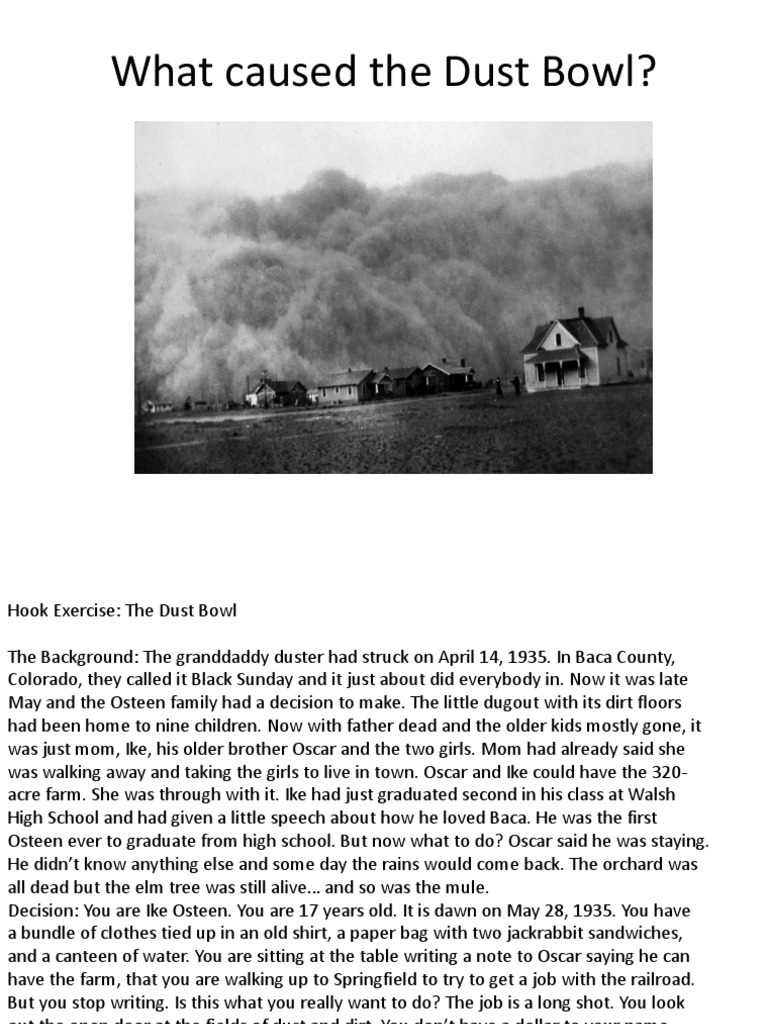
The scorched earth of the Great Plains in the 1930s wasn’t just a product of drought and poor farming techniques. Peeling back layers of history, we uncover the profound influence of economic ideology – the system we call capitalism – as a primary and often overlooked driver of the environmental catastrophe known as the Dust Bowl. This exploration ventures beyond the simplified narratives of ‘bad farmer behavior’ to reveal how the relentless pursuit of profit and economic expansion systematically unravelled the ecological fabric of the American West.
Economic Promises of the Frontier: The Capitalist Imperative
The vast expanse of the Great Plains, stretching like an endless frontier, held immense appeal under the tenets of rugged individualism and boundless opportunity. Capitalism, with its embedded promise of manifest destiny and the acquisition of wealth through land and labor, drew settlers westward not merely seeking homes, but seeking fortunes. The land itself was reimagined through an economic lens. Its primary perceived value, in the context of booming grain markets and speculative investment, was its capacity to yield a cash crop, wheat. This economic perspective eclipsed, for many settlers, the deep historical understanding of Native American knowledge regarding the Plains’ delicate ecology as primarily suitable for grazing, not intensive agriculture.
The narrative shifted dramatically from viewing the Plains as a difficult but manageable landscape to seeing it as a veritable cornucopia capable of rewarding limitless exploitation. Homesteaders were encouraged, subsidised, and driven by the dream of ownership leading to economic independence – a truly American self-made success story. As historian Donald Worster often notes, this era was marked by a potent “corn crusade,” where the perceived abundance of the flat lands and the global demand for wheat fuelled a relentless drive for cultivation. The economic logic was clear: convert more acreage to wheat production, secure a loan, harvest, sell – repeat. This focus relentlessly narrowed, ignoring – or actively disregarding – the complex, previously stable interactions between the grasses, the soil, and the climate.
Capital Accumulation and the Seeds of Soil Degradation
Once settlers arrived, the demands of the market economy pushed agricultural practices to the edge. Owning land generated pressure to maximise its productivity and economic yield. The economic system inherently promoted intensification. This translated quickly into the adoption of technologies designed to boost production: steel plows cutting ever deeper furrows, harrow combinations smoothing the land for planting, and, crucially, the widespread planting of annual hard wheat varieties, chosen because their stalks would fall over (lay down) under the prairie-like winds, making harvest easier and supposedly preventing soil erosion. However, this was a flawed technological leap; the fall-over potential of this wheat required heavy harvesting machinery, and the seeds for reseeding were vulnerable. These new systems, while boosting short-term returns, fundamentally disrupted the established equilibrium.
Furthermore, the pursuit of economies of scale and higher yields fostered the near-total abandonment of native grasses, the ecosystems’ natural groundcover. As the grass cover was systematically removed for planting, the topsoil, previously held in place by roots and grass residues, became vulnerable. The wind, unimpeded, offered no resistance to the exposed, dry earth waiting to be harvested. Ecological logic yielded to financial logic – eroding the very resource base that generated profit. The relentless conversion of prairie to plowed fields, combined with the new farming equipment that left the soil loose and dry between crops, created a feedback loop: higher production → deeper plowing → more erosion → declining soil fertility and yield, forcing even greater soil exposure to secure the same output. This was the systematic self-immolation of the Plains ecosystem under the guise of economic progress.
The Credit Levers: Financing Irresponsible Land Use
Capitalism’s relentless demand for capital could be met, at least on the plains, by the vast agricultural credit systems controlled by corporations like Armour and Company and the Farmers’ Loan and Trust Company. These institutions provided enormous, often low-interest, access to cash for land purchases and, crucially, for borrowing against anticipated crop yields before harvest – a system known as pre-shipment credit. This financial architecture incentivized risk-taking; farmers could buy land, expensive equipment, and necessary inputs long before knowing if their crops would fetch a profit. The debt structure itself created pressure to produce results, escalating the risk.
This system, championed by agricultural economists and policymakers influenced by ideas from figures like Henry C. Carey regarding “improvement” through cultivation, normalized borrowing beyond prudent limits. Land was over-valued due to speculation fuelled by the belief in endless agricultural bounty. When harvests failed – initially less common before the full drought – the resulting debts left countless families and small companies bankrupt. Entire regions, mortgaged beyond any rational valuation of their productive capacity under normal conditions, were now dangerously exposed. The consequence of this high-stakes lending was not financial stability, but the very real potential for total economic collapse when nature, inevitably, provided less wind or rain than required. The pursuit of capital gains and market access sacrificed long-term ecological security for short-term loans and speculative booms.
Capitalism’s Social Dislocation and Technological Oversight
The drive for economic activity led to the clearing of timber stands (in some regions, like the shortgrass prairie, previously mistaken for useless “juniper” or “timber”) and, critically, to the removal of ecological knowledge holders – Native Americans. The establishment of the Bureau of Indian Affairs and the Dawes Act aimed, through forced allotment and assimilation, to break up communal land holdings and encourage individual ownership based on a European-American model. Dispossessing tribes disrupted millennia-old sustainable practices and further denuded the land base from another angle.
Simultaneously, technological solutions were developed almost entirely from an economic perspective, rather than an ecological one. Soil testing focused on chemical composition relevant to crop growth, not long-term sustainability. Agricultural extension services, often university-based, encouraged and subsidized practices like deep plowing to improve soil structure (based on then-current flawed ideas – an error that persists even today) or specific planting densities optimized for yield. The government provided maps of soil types primarily to help farmers choose land suited to cultivation, implicitly ignoring that all native soils in the region, due to the past climate and vegetation, were inherently well-suited to agriculture. This scientific guidance, intended to improve efficiency and productivity, laid bare more land to the whims of weather and economics, providing the foundation for widespread, systematic soil erosion. The pursuit of measurable, immediate economic benefits eclipsed the need for understanding and preserving complex natural systems.
Conclusion: The Dust Bowl as a Wake-Up Call
The environmental horror of the Dust Bowl was not spontaneous combustion. It was a predictable, albeit perhaps avoidable, consequence of a specific historical moment – the confluence of a demanding global economy, nationalist expansionism, and a financial system that incentivized short-term gain over long-term sustainability, all concentrated on a fragile landscape. The legacy of this event is deeply unsettling. It demonstrates that environmental management cannot be separated from economic systems. When market forces, driven by the accumulation of capital, disregard the fundamental laws of ecology, the results can be catastrophic. The policies and pressures that led to the Dust Bowl remind us that the relationship between people and the land is not merely one of extraction, but one requiring wisdom and balance – lessons learned with painful clarity during the dust-choked years of the Great Depression. The economic model itself, rather than specific policies, proved a critical factor in the ecological disaster, demanding a new, more thoughtful ecological economics for humanity’s continued interaction with its natural foundations.


