Imagine the bedrock tenets of capitalism – maximizing profit through production and exchange – now ask it to adapt to a world saturated with data flow and unprecedented monitoring capabilities. “How capitalism creates surveillance capitalism” isn’t merely a descriptive phrase; it hints at a profound reconfiguration of economic activity. It suggests that capitalism, in its relentless pursuit of growth and efficiency, has discovered not just a new product or market, but an entirely new way to generate value: by observing and understanding human behavior at an unprecedented scale. This is surveillance capitalism, a phenomenon born from the fusion of late-stage capitalism’s imperatives and the digital age’s technological explosion.
Capitalism’s Profit Motif: E pluribus unum
At its heart, capitalism thrives on transforming units of effort or scarcity into units of value. Its genius lies in the aggregation, standardization, and exchange of these units. Traditional capitalism built empires on manufacturing, distribution, and consumer spending. Surveillance capitalism represents a radical permutation: it posits that individual behavior – minute-by-minute digital footprints – is a novel, highly concentrated form of value. It’s the transformation of human attention and choice trajectories into currency, a potential source of ongoing, measurable dividends (‘data dividends’) for its proponents.
The Relentless Engine of Value Extraction
Capitalism isn’t static; it evolves. When the limitations or discontents of one phase become apparent – perhaps due to changing tastes, resource scarcity, or technological disruption – capital seeks new arteries through which to flow. Surveillance capitalism emerged as capitalism’s most ambitious effort yet to identify and capture novel streams of value. The core function of any capitalist enterprise is extraction: identifying a unit of value and maximizing its throughput. The transition towards surveillance capitalism sees entrepreneurs identifying the unit of value as the patterns contained within digital traces, the unique behavioral signatures of individuals navigating platforms.
The Behavioral Data Shift
The pre-digital era operated with behavioral scarcity. Markets were often segmented, individual histories were largely unrecorded outside bureaucratic ledgers, and insights into consumer action were indirect. The digitization of life – banking, commerce, social interaction, entertainment even health – creates an ocean of behavioral data. Unlike the sparse, aggregated indicators of yesteryear, this data stream offers granular, real-time insights into human decisions, desires, and predictabilities. The shift isn’t just volume; it’s from *aggregated* data points to complete *behavioral logs*.
Fueling the Economic Logic
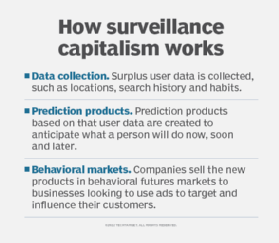
Surveillance capitalism emerged hand-in-hand with the rise of user-centric platforms – social media networks, search engines, digital marketplaces. Providing the core service often requires constant measurement. This measurement itself becomes integrated into the value proposition. By meticulously cataloguing user clicks, scrolls, searches, location, and interactions across the digital universe, these platforms accrue value not just by connecting buyers and sellers or serving ads, but by developing precise predictive models about individual users. This predictive power – the ability to forecast likely future behaviors – is the engine that drives new product development, service customization, and targeted advertising revenue streams.
The Paradox of Personalization
One of surveillance capitalism’s most insidious appeal mechanisms is hyper-personalization. Capitalism traditionally seeks to broaden markets by offering standardized goods to the mass market. Surveillance capitalism flips a portion of this script. The detailed behavioral data allows for micro-segmentation. This leads to hyper-specific product or service modifications designed to resonate deeply with specific individuals or micro-communities. While seemingly tailored, this hyper-personalization often reveals something fundamental: markets are being reconquered not en masse, but through data-driven behavioral conditioning, blurring the line between authentic desire and algorithmically steered compulsion.
Crisis of Transparency
Whereas conventional capitalism relies on transparency in property rights and contracts (even if market power imbalances exist), surveillance capitalism operates on a foundation of radical opacity in its central value-extraction mechanism – the behavioral data collection, processing, and use. Consumers rarely fully grasp what data is being collected, how it’s linked across services, sold, or used to create psychological profiles for prediction and manipulation. The inherent lack of transparency is a core vulnerability, making systemic resistance or market failure difficult to engineer from outside.
Adaptation and Resistance
Capitalism’s inherent flexibility ensures that surveillance capitalism is evolving. Resistance manifests, as seen in privacy regulations (like GDPR and CCPA), demands for greater algorithmic transparency, and grassroots movements opposing invasive surveillance. The digital native generation grows wary. Firms themselves are inventing new ways to monetize data without direct behavioral scanning (like federated learning or differential privacy), though the ethical implications remain contested. Yet, the pressure remains immense for platforms and businesses to leverage user attention and data for competitive advantage.
Surveillance Capitalism as a New Model
To fully grasp the scale of this phenomenon, consider surveillance capitalism established as a distinct economic model, now jostling for ground space in the broader capitalist ecosystem alongside traditional manufacturing, service provision, agriculture, or finance. Its scale is planetary, driven by the unprecedented concentration of user behavior data flowing through digital infrastructure. Its profits are derived not from production margins but from data flows and behavioral predictions, leveraging the concentration of human attention in increasingly competitive (and zero-sum) data fields.
A Continuously Evolving Dynamic
The question remains: is this merely the current phase of capitalism, or a precursor to its next iteration? The trajectory appears set: data acquisition, behavioral understanding, prediction, and targeted intervention will become foundational economic activities. The friction between surveillance capitalism’s value-extraction logic and its promises of user empowerment, privacy, and ethical conduct is driving a complex, ongoing negotiation. This isn’t hyperbole; it’s the mapping of how capitalism’s core drive – the relentless search for value – has successfully identified a novel reservoir: the intricate patterns of human existence, mapped in ones and zeros, and potentially monetized ad infinitum.


