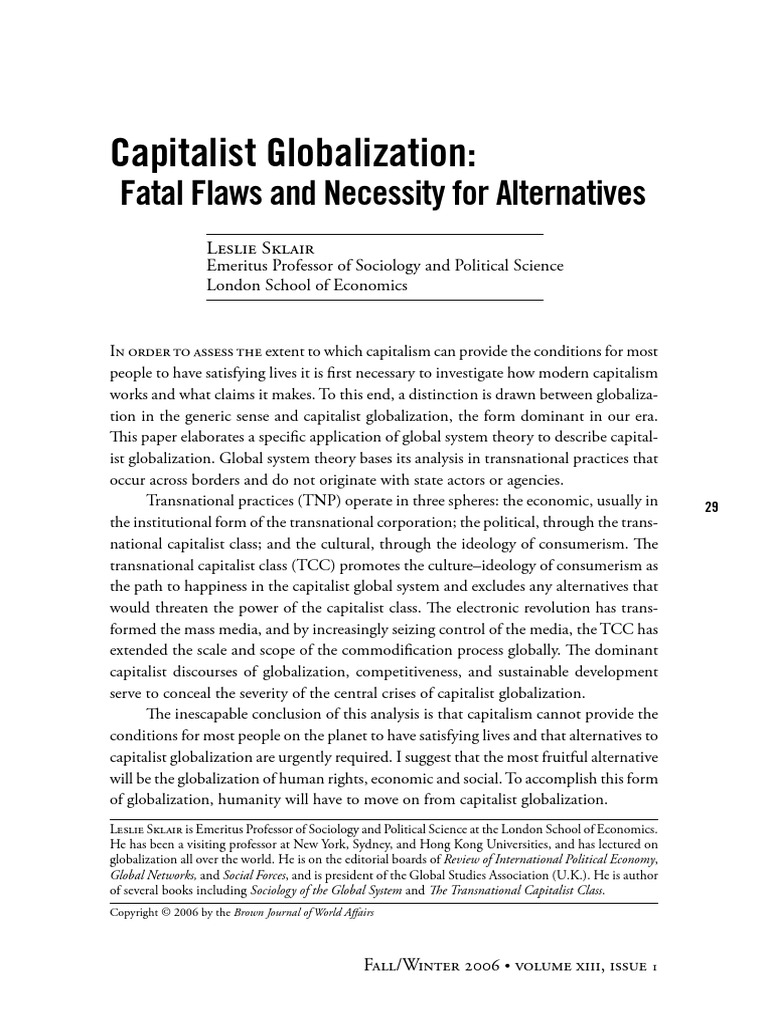
Globalization is often perceived as an inevitable, natural evolution of human societies—an unstoppable force knitting together disparate cultures, economies, and technologies. Yet, beneath this commonly accepted view lies a complex interplay of economic systems and ideologies, with capitalism standing as the principal architect of globalization’s modern form. The fascination with globalization often springs from its vast, almost dizzying scale—the seamless flow of goods, services, capital, and information across borders. This seamlessness, however, is not a mere happenstance but the product of capitalism’s inherent dynamics and mechanisms that have redefined connectivity and interaction on a global scale.
The Capitalist Impulse for Expansion
At the heart of capitalism lies a profound impulse: the relentless pursuit of growth and profit maximization. Unlike earlier economic paradigms that might have focused on local self-sufficiency or rigid hierarchies, capitalism demands constant expansion. This drive necessitates exploring new markets, resources, and consumer bases. The incentive structure ingrained in capitalist markets compels businesses to look beyond their immediate environment, forging international trade links and fostering economic interdependence across continents.
This compulsive expansionism is foundational to globalization. The thirst for accumulation doesn’t recognize national boundaries. Instead, borders become porous checkpoints in an otherwise continuous pathway for capital flows and commercial exchange. Historically, this urge manifested in the numerous trading empires and mercantile ventures, but capitalism’s innovation was in institutionalizing and accelerating this process through financial instruments, corporations, and global supply chains. The global marketplace emerged as an inevitable space where capitalist actors continuously seek new avenues to sustain growth.
Technological Innovation and Capitalist Incentives
Technology is the lifeblood of globalization, shrinking distances and slashing transaction costs. Yet, capitalism is the mechanism that transforms inventions into widespread tools of interconnectedness. The competitive nature of capitalist economies fosters intense innovation, particularly in communication, transportation, and logistics—each a pillar supporting globalization’s infrastructure.
The steam engine, telegraph, container shipping, and the internet all revolutionized the capacity for cross-border exchange. These technological leaps were not mere subsidies to globalization; they were responses to market incentives under capitalism. Entrepreneurs and corporations recognized that investing in technology could dramatically increase efficiency and profits. Capitalist economies thus create fertile ground where innovation thrives—not for its own sake, but as a crucial lever to conquer new markets and reduce barriers to trade.
Consumerism and the Global Demand Network
Globalization’s fascination often springs from the ubiquity of goods from every corner of the world, exposed in hypermarkets and online platforms. This is a direct consequence of capitalist consumerism. Capitalism’s evolution nurtured not only the means of production but also the culture of consumption, where desires are constructed and amplified by advertising, media, and the market itself.
The global demand network results from this continuous cultivation of consumer wants, which transcends local tastes and embraces cosmopolitanism. Capitalism facilitated the creation of vast consumer bases unified by shared desires for convenience, novelty, and brand prestige. These consumer markets, in turn, incentivize companies to source materials and labor from various geographies, integrating production and supply chains into global mosaics.
This interconnectedness fuels a feedback loop: consumers expect variety and affordability, companies optimize cross-border efficiencies, and technology bridges distances—all undergirded by capitalist imperatives. Ultimately, such expansive consumerism does not merely reflect globalization; it demands and accelerates it.
Financial Capital Flows as the Arteries of Globalization
Capitalism’s financial architecture is a crucial enabler often overlooked in everyday discussions of globalization. Capital does not simply sit passively in local banks or factories; it actively seeks the most lucrative opportunities worldwide. The deregulation of financial markets and innovations in banking, stock exchanges, and investment instruments have turned money into a highly mobile and speculative entity.
Foreign direct investment, portfolio investment, and international lending all illustrate how capital navigates global terrains in search of profit. This fluidity binds national economies, creating dependencies and networks that are resilient yet vulnerable—characterized by the rapid transmission of economic shocks and boons alike. Thus, the financial mechanisms birthed by capitalism underpin the intricate lattice of globalization, orchestrating flows that sustain production, consumption, and innovation on an international scale.
Capitalism’s Institutional Framework and Global Governance
Beyond the economic and technological aspects, capitalism has shaped the institutional landscape that makes globalization administratively feasible and legally defensible. International organizations, trade agreements, and regulatory norms create a predictable environment where capital can traverse national borders with minimized friction.
The establishment of bodies like the World Trade Organization or multilateral investment treaties exemplify how capitalist interests are institutionalized at a global level. These frameworks stabilize expectations, reduce tariffs and barriers, and harmonize rules, ensuring that capitalist enterprises can operate efficiently and predictably worldwide. Institutional legitimacy and enforcement mechanisms further embed globalization into the fabric of international relations, facilitating a global order conducive to capitalist expansion.
The Paradoxes and Critiques Embedded in Capitalist-Driven Globalization
While capitalism has undeniably propelled globalization, this relationship is fraught with contradictions and tensions. Globalization promises greater prosperity through open markets, yet it often exacerbates inequalities—between nations, classes, and within communities. The capitalist engine accelerates environmental degradation through relentless resource extraction and consumption patterns, challenging sustainability.
Moreover, the capitalist-driven global order can provoke cultural homogenization, sparking debates about identity and sovereignty. These paradoxes evoke the deeper reasons behind society’s ambivalent fascination with globalization: it represents progress and connectivity, but also disruption and dislocation. Capitalism’s role is neither purely benevolent nor malevolent; it is a dynamic force whose consequences ripple across economic, social, and geopolitical realms.
Conclusion: A Capitalist Constellation Enabling Globalization’s Gravitational Pull
The phenomenon of globalization, while often viewed in abstraction as an inevitable march toward unity and integration, is intrinsically tethered to capitalism’s imperatives and innovations. The insatiable desire for expansion, the catalytic role of technological innovation, the cultivation of a global consumer culture, the mobility of financial capital, and the scaffolding of global institutions collectively compose the constellation that draws the world into a capitalist orbit.
This intricate interdependence explains both the magnetism and the tensions of globalization. Capitalism did not merely make globalization possible—it made it compelling, lucrative, and inescapable. Understanding globalization requires recognizing this profound and multifaceted relationship, delving beyond superficial observations to grasp the economic and ideological engines that continually reshape our interconnected existence.

