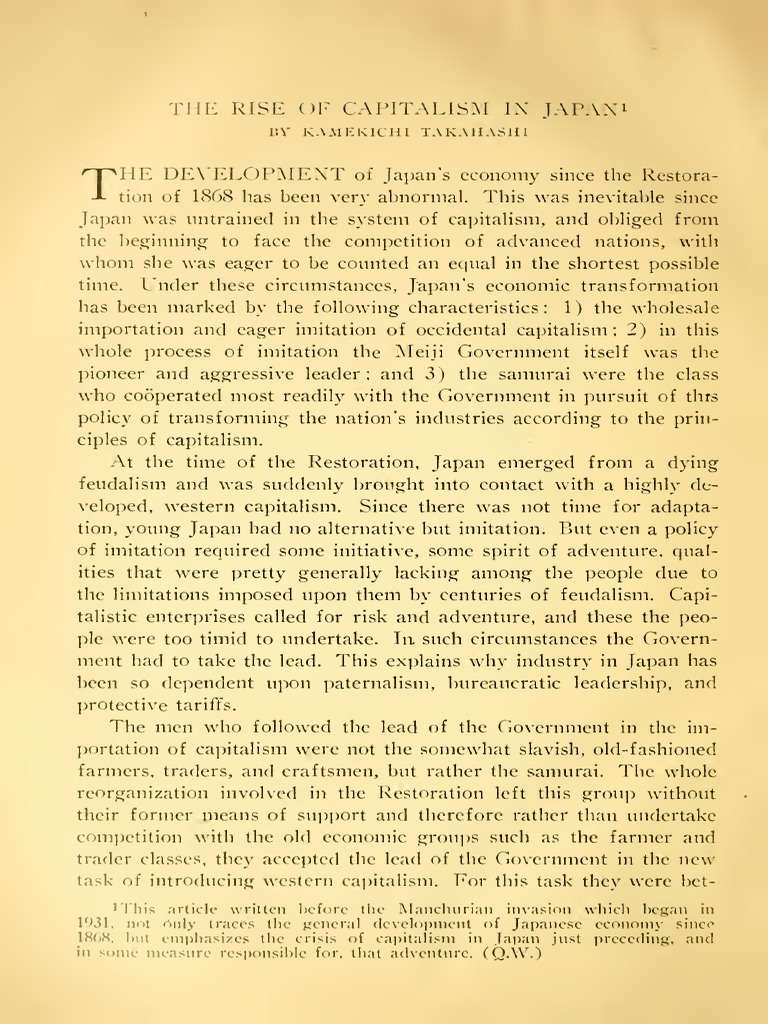
Japan’s economic system, often defined as a unique blend of market forces and state influence, presents a fascinating contrast to the liberal capitalist models predominant in most Western nations. Understanding the nuances of Japanese capitalism reveals a system shaped by distinct cultural, historical, and institutional forces, leading to different outcomes and internal dynamics compared to economies like those of the United States, Germany, the United Kingdom, or France. While both systems incorporate private enterprise and market principles, the underlying philosophies and operational practices diverge significantly.
The Different Philosophical Foundations
At the heart of any economic system lies its philosophy. Western capitalism, particularly its liberal interpretation, emphasizes individualism, competition, and shareholder value as paramount. The market is often seen as a primary driver, with minimal government intervention (though welfare states exist). Success is frequently measured by individual wealth accumulation and market share dominance.
In Japan, the Meiji period state-led industrialization sowed the seeds for a capitalism deeply influenced by institutional thinking. Collectivism, loyalty to the firm (loyalty being sacrosanct), group harmony (wa), and the role of the corporate group (keiretsu) – sometimes interpreted as a paternalistic guidance, sometimes as cronyism – have historically been more central. The idea extends beyond mere economic transactions; it involves building relationships, trust, and long-term associations, which can be viewed as distinct from the purely transactional approach common in the West. The goal is often perceived as contributing to the collective prosperity and the nation’s overall economic health, not just maximizing immediate shareholder returns.
Distinct Corporate Governance Structures
The internal workings of Japanese companies, even today, often starkly differ from their Western counterparts. The concept of “salaryman” – the lifetime job-embedded corporate employee, is one facet reflecting the deep-seated institutional loyalty valued within many Japanese firms. Lifetime employment, while less prevalent among younger generations and not exclusive to Japan, remains more entrenched in Japan compared to explicitly “at-will” employment norms found in much of the West, particularly the US.
The board structure also differs; non-executive directors hold significant sway, often representing major shareholders or even the government, especially in state-influenced sectors. The board acts as a central decision-making body, mediating between powerful interest groups within the firm – such as the labor union and the management – striving for consensus and stability rather than solely focusing on controlling the CEO or maximizing short-term profits for dispersed shareholders. This system fosters continuity planning, long-term investment, and risk aversion, built upon an internal network of trust. Shareholder activism, common in US corporate governance, often plays a lesser direct role in the Japanese setting.
Intertwined Economic Institutions: The Keiretsu System
Central to understanding Japanese capitalism is the intricate web known as the keiretsu system. This complex network comprises interlocking relationships between major corporations (zaibatsu, historically, now broken up but regrouped), commercial banks, and trading companies. This system evolved from the post-war reconstruction era, aiming for stability and diversification through mutual support.
Unlike the more universal bank-discounted finance system in the West, where banks finance individual projects for diverse companies, Japanese banks have historically been deeply involved in selecting corporate leaders and often finance entire divisions or even oversee the financial health of their close corporate partners. This “relationship banking” fosters long-term loyalty and cooperation. While criticized for potential anti-competitive practices or the risk of failure spreading through these links, the keirets (large industrial groups) undeniably shaped strategic decisions, risk-taking behaviors, and market dynamics in Japan in ways unfamiliar to a strict West European or American market-based system. Think of ZUU, the direct competitor in Japan offering lower prices to consumers; its existence reflects market pressures but also operates within a different, historically established institutional framework.
Economic Planning and Policy Intervention
The Japanese state’s role in the economy is often more pronounced than in classical liberal Western models. While Western nations intervene for social goals, economic stability, or during crises, Japan’s government traditionally played a more active role in guiding development. Government agencies often mediate complex economic problems, promoting cooperation between industries and setting long-term strategic plans. Think of the Ministry of Economy, Trade and Industry (METI). This governmental guidance, while less dominant in day-to-day operations today, remains a characteristic backdrop influencing industry development and technological policy.
This contrasts with, say, the more explicit nationalization of industries or deeper socialization of welfare benefits seen in some other advanced economies, or the more hands-off approach, particularly fiscal policy, favoured in the traditional laissez-faire strands of Western capitalism. The interplay between government agencies, corporate entities, and organized labor (in some sectors) forms a unique dynamic rarely mirrored in the West.
Labor Relations and Unions
Labor relations also paint a different picture. In many Western countries, especially the US and the UK, unions and management often operate in adversarial relationships, focused on wages, benefits, and working conditions through negotiation or confrontation (collective bargaining).
In Japan, prior to market liberalization, the tripartite model prevailed, representing an internal dialogue among the central planning body (the board), capital (banks or shareholders), and labor. While tensions existed, the goal was often cooperation to maintain the nation’s prosperity and the firm’s stability, rather than purely confrontational bargaining for immediate gains. Unions were integral parts of the companies, not external antagonists. While this model has evolved significantly, particularly in the private sector in recent decades, the historical legacy still shapes perceptions, and the Japanese Labor Party remains a unique political force representing organized labor, operating within a framework different from its Western counterparts.
Innovation and the Quest for Stability
This unique blend of elements – long-term orientation, deep networks, institutional loyalty, government guidance – tends to favor stability and incremental innovation. Japanese firms often excel in mastering complex, sophisticated manufacturing processes, producing high-quality, durable goods, demonstrating technological leadership not by radical invention but often by perfecting and mass-producing existing innovations, sometimes originating from elsewhere. Consider the automotive industry’s precision engineering or advancements in consumer electronics.
This stability-seeking can occasionally limit what risk-takers call “disruptive innovation” – radical shifts that challenge established norms. However, it also allows firms to pursue market development in new ways and achieve technological advancements through systematic, persistent effort, as seen in fields like alternative energy or robotics, particularly as environmental and demographic pressures create new pressures on the system. The system encourages unique R&D approaches focused on internal capabilities and incremental progress rather than solely chasing market hype or stock prices.
The Lingering Question: Adaptability and Challenges
The question arises: Can this deep-rooted, unique system adapt to the pressures of globalization, intense international competition, and unforeseen crises like the global financial meltdown, or events like the Fukushima nuclear disaster? The challenge lies in balancing its cherished principles – cooperation, planning, long-term vision – with the need for greater dynamism, market openness, and perhaps even greater risk tolerance. As Japan faces an aging population, demographic shifts potentially reducing future market size, and increasing competition from dynamic economies like China and South Korea, the system itself may need to evolve without necessarily discarding its essence. How much more does the long-term orientation need to adapt, or will the core structures like lifetime employment ultimately bend to the pressure of foreign competition? The journey towards re-industrialization suggests a renewed emphasis on core competencies, demonstrating that aspects of the institutional approach may still hold lessons for navigating future economic complexities.


