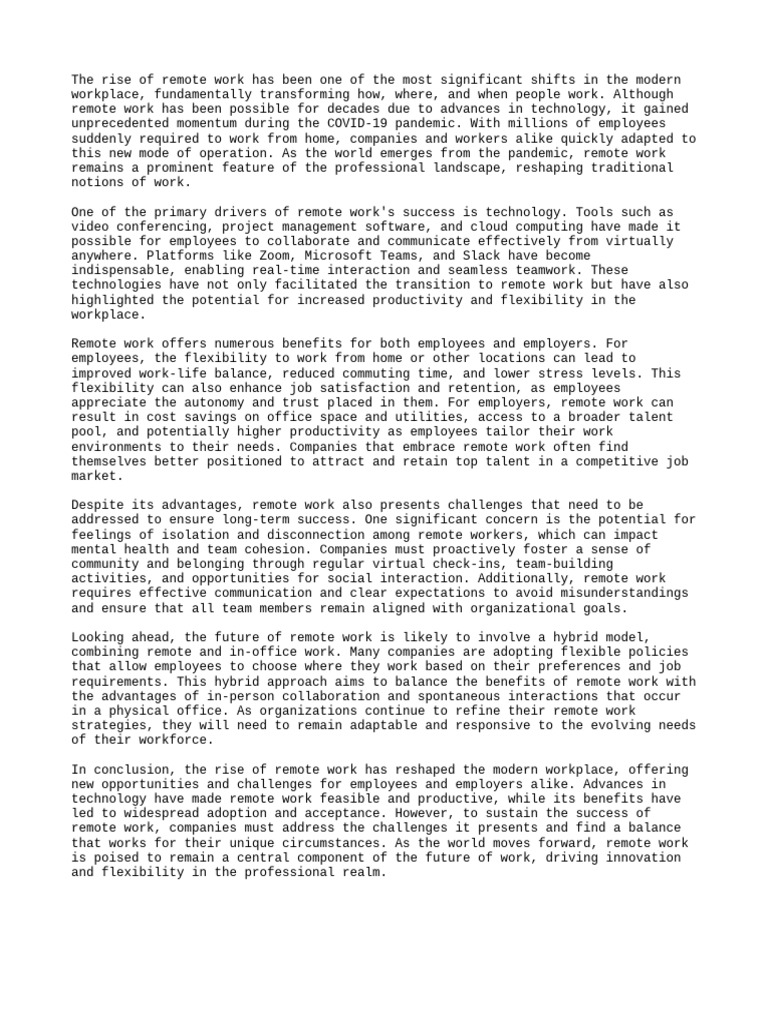
Remote work, once a niche perk or a long-awaited fantasy for some, has become a fundamental shift, reshaping not just how we commute but how we labor within the capitalist system itself. The narrative surrounding productivity under remote work often begins, predictably, with debates that echo pre-pandemic anxieties: Are distributed teams clicking away from coffee shops and sun-drenched home offices truly as efficient as those in climate-controlled headquarters? Do the blurred lines between work and personal time lead to burnout or to unprecedented flexibility? This initial tension captures a common observation, but it merely touches upon the surface of a deeper, more complex transformation – a shift in the very structure of labor and its relationship to capital.
Ambiguity in Output vs. Time Clock Arbitrage
The foundational measure of productivity in corporate capitalism, for much of its history, rested heavily on the physical presence within the workplace, implicitly linked to the eight-hour workday. Remote work throws this paradigm into flux. While technological platforms facilitate monitoring and communication, the direct correlation between visible presence and tangible output dissolves. As a result, the “productivity” metric often shifts, sometimes arbitrarily, from easily quantifiable tasks (e.g., lines of code written, reports emailed) towards qualitative indicators like project completion, client satisfaction, or perceived engagement, all influenced by context unknown to the manager. This ambiguity breeds both opportunities and anxieties. For employers, it necessitates new forms of trust-based management and alternative performance metrics, challenging traditional control mechanisms. For workers, it introduces the phenomenon often termed “temporal arbitrage” – the struggle to define and defend the boundaries between work hours and personal life.
The Reshaping of Work Hours: A Capitalist Dream Reimagined?
Capitalism thrives on the concentration of labor, enabling economies of scale and synchronous collaboration, often demanding peak focus during core business hours. Remote work, particularly widespread asynchronous models, disrupts this concentration. Yet, the allure persists: for companies seeking global talent pools without geographical constraints, and for individuals escaping commutes and seeking location independence. This seemingly contradictory dynamic highlights a deeper shift – the potential dismantling of the rigid, location-dependent 9-to-5 schedule. Remote work enables not just flexibility within set hours, but the possibility of living in regions with lower operational costs, fundamentally altering the cost structure for businesses and even geographic arbitrage itself. This flexibility hints at a future where the 8-hour workday might be just one historical chapter in the ongoing evolution of work organization.
Culture Clash: The Slow Death of the Corporate Camel? Or Evolution?
Remote work fundamentally challenges the traditional notion of the physical office as the primary locus of corporate culture. Water coolers facilitate informal collaboration, office gossip binds teams, and visible colleagues serve as social lubricants and accountability mechanisms. Virtual workspaces attempt to replicate these interactions through forums, video meetings, and online chats, but digital communication inherently lacks nuance (the infamous lack of “reading my lips”). This de-culturing effect isn’t necessarily negative; it can foster more deliberate and articulate communication, flatten hierarchies, and allow less extroverted individuals a more comfortable voice. However, it also risks creating a sense of disembodied work, potentially fostering deeper alienation for some, or paradoxically reinforcing group identity within smaller, highly connected remote teams. The corporate “camel,” if we picture it as embodying traditional presence, is perhaps not dying, but being replaced by a more distributed, less physically cohesive, yet potentially more dynamic, corporate “alpaca” or “beetle,” each form born of different temporal and spatial needs.
Time, Attention, and the Commodification of Focus
In the pre-remote era, the office environment was designed to combat the dual problems of time-bound “deep work” – the sustained concentration required for complex tasks – and constant workplace distraction. Remote work removes many traditional office hurdles, freeing potential for intense focus. However, it introduces new, largely intangible challenges. Constant notifications, online meetings that bleed into personal hours, and the blurring of work identity with personal identity create a persistent demand for “attention,” a finite and valuable resource now potentially more contested at a cellular level than ever before. Companies increasingly value not just focused hours but the ability to summon individual attention rapidly upon a digital ping. This commodification of fragmented attention fragments work rhythm and places immense psychological pressure on individuals to be perpetually responsive, hinting at a future where “availability” itself becomes a form of capital, even when the work output isn’t immediate.
Identity Redrawing: The Worker Beyond the Cubicle
The experience of work contributes significantly to individual identity. The physical office space often provided tangible markers of belonging – the corner office, the swanky amenities, the shared rituals like Friday drinks. Remote work fundamentally redraws this territory. The identity of the employee is increasingly tied to a digital environment – Slack channels, company wikis, virtual stand-ups. This shift fosters a degree of anonymity that can be liberating for some, allowing them to define their contribution without the physical constraints of a uniform or office politics. Yet, there’s a cost. The loss of the physical work environment as a shared point of reference can weaken group cohesion, albeit in ways that may be more fluid and less hierarchical than traditional structures. The individual stands not just as a cog in a distant machine but as a node in a global network, their identity less shaped by their physical surroundings and more by their digital reputation and specific project roles.
The Precarious Productive Path: Resilience or Future Pragmatism?
Digital platforms like the one referenced here provide a vast repository of content, reflecting and fueling our obsession with productivity metrics in the digital age, including remote work. But the future of remote work and its perceived productivity remains contingent on numerous variables. Not all roles translate well to remote settings, leading to potential segmentation of the labor market and creating new forms of advantage for those adaptable enough (or willing) to adopt these new models. The productivity gains hinge on factors like technological infrastructure, the specific nature of the work, and the collaborative structures established. Remote work is undeniably reshaping labor, offering unprecedented flexibility and access to talent, but its long-term viability as a universal solution is still under empirical scrutiny. The fascination with remote work’s productivity impact, therefore, is perhaps a reflection of capitalism’s ongoing struggle to find its most efficient human configuration. The underlying reasons for our collective gazing are the perennial quest for optimization, the inherent contradictions between capital’s drive for control and flexibility, and the complex interplay between technological possibilities and human behavior, all unfolding in the fertile ground of the distributed workforce.

