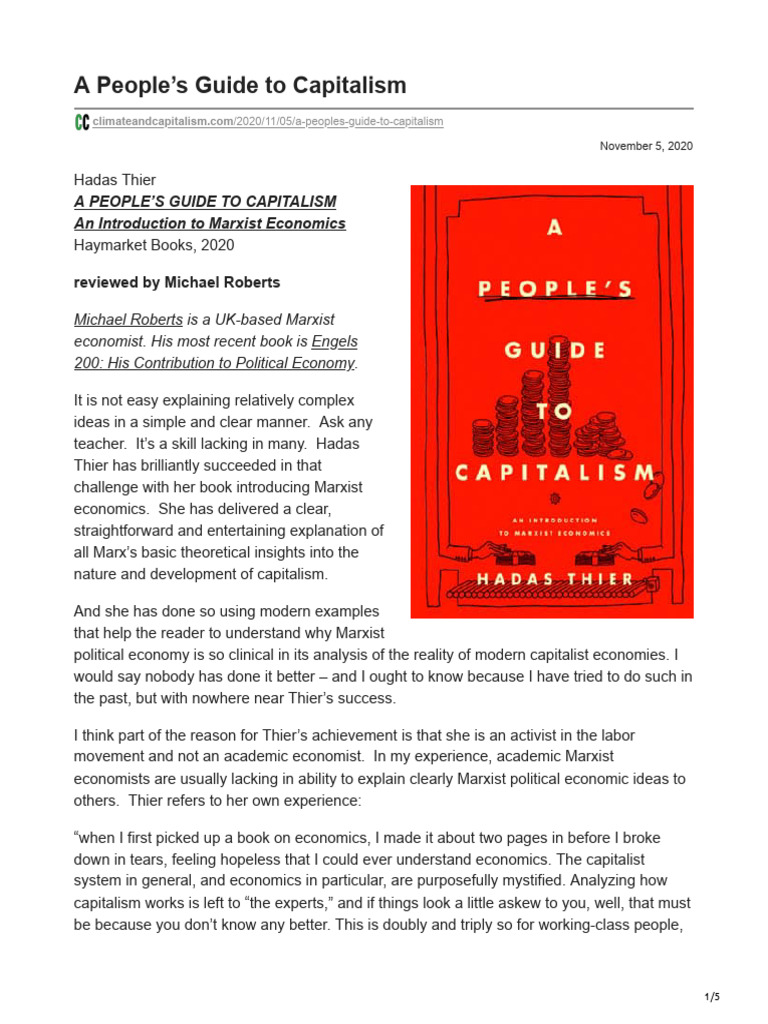
The notion of leaving capitalism behind evokes a profound shift, a quest not merely for economic escape but for a fundamental change in perspective and environment. Capitalism, in its contemporary form, often presents itself as an inescapable juggernaut, its logic woven into the fabric of society itself. Yet, the persistent allure of alternatives, however nebulous, suggests a deep human yearning for different modes of existence. “A People’s Guide to Capitalism,” as a title suggests, invites us not just to understand but perhaps, to imagine ways beyond this dominant system. This small guide explores such avenues, using metaphor not as flattery for the status quo, but as unique lenses through which we might glimpse the contours of what might lie beyond.
Arcane Realms and Elusive Promises
To leave capitalism behind, one must first engage with its intricate inner workings, its seemingly self-perpetuating cycles, and the power dynamics that sustain it. Consider its operational logic: a vast, intricate machine driven by competition, consumption, and capital accumulation. While ostensibly designed for progress and efficiency, this engine often grinds the gears of community, slows the pace of life, and demands conformity to its rigid rules for survival. Its promises – of choice through market access, security through property ownership, and opportunity through merit – are often tested against harsh realities: economic inequality, environmental degradation, the dehumanizing pressures of constant comparison, and the alienation inherent in treating labor merely as a cost or a mere input.
Constriction, Conflict, and Saturated Landscapes
The feeling of constriction under capitalism isn’t always about overt oppression. Often, it manifests more subtly: the pressure to participate, the anxiety of falling behind, the sense that one’s efforts and desires are evaluated solely within its competitive metrics. This system thrives on demand, constantly amplifying needs until they become wants, or even requirements for survival in distorted ways. It creates a landscape of endless pursuit, where scarcity is manufactured to drive consumption. Leaving it behind means seeking spaces free from this particular dialectic of scarcity and saturation, spaces where provision and sufficiency can be defined differently, perhaps outside of market imperatives.
Alternative Foundations, Embodied Ideals
If capitalism is built on the inviolable principles of individual ownership, freedom defined through market access, and wealth accumulation as the primary measure of success, then alternatives must be consciously constructed around different foundations. These might include shared ownership models, systems prioritizing communal well-being and environmental stewardship, frameworks where needs guide resource distribution (even if imperfectly), or societies built on principles of reciprocity, subsistence harmony, or gift economies. These alternatives aren’t necessarily perfect blueprints, but rather consciously articulated ideals – often, they are the lived realities of alternative communities, intentional movements, or historical experiments that offer glimpses of how value could be defined, how cooperation could function, and how existence might unfold without the pervasive logic of capital at its core.
The Perils of Transition, The Blueprint within
Leaving capitalism behind isn’t simply about withdrawing into an alternate reality; it necessitates navigating the complexities of transition. Discourse and critique are essential, but translating ideals into practice is fraught. One must contend with entrenched interests, the psychological weight of decades of normalized systems, and the challenge of organizing human cooperation on fundamentally different terms. Yet, the transition is also reflected *within* the system’s logic. The search for alternatives, the desire to escape its constraints, and the very existence of communities and movements charting different paths implicitly offer blueprints, albeit often radical and small-scale ones. These alternative structures serve as crucibles for experimentation, providing practical knowledge, reinforcing shared values, and demonstrating that different forms of organization are possible.
Horizon of Hope, Resonant Visions
The allure of leaving capitalism behind isn’t necessarily tied to nostalgia or a desire for hardship but to the promise of a different future – one potentially defined by greater equity, ecological balance, meaningful work, and genuine autonomy. It requires a willingness to question the deeply ingrained assumptions underpinning our current reality. This journey involves building new languages, cultivating new worldviews, and fostering resilience against the anxieties capitalism cultivates. Finding one’s footing outside the prescribed contours means embracing uncertainty, valuing solidarity, and seeking solace and strength in connection, rather than solely in consumption and accumulation. It requires looking beyond the familiar landscape and towards horizons painted not with the colors of profit, but with a richer tapestry of shared meaning, possibility, and diverse, perhaps even conflicting, visions for a world yet unwritten.

