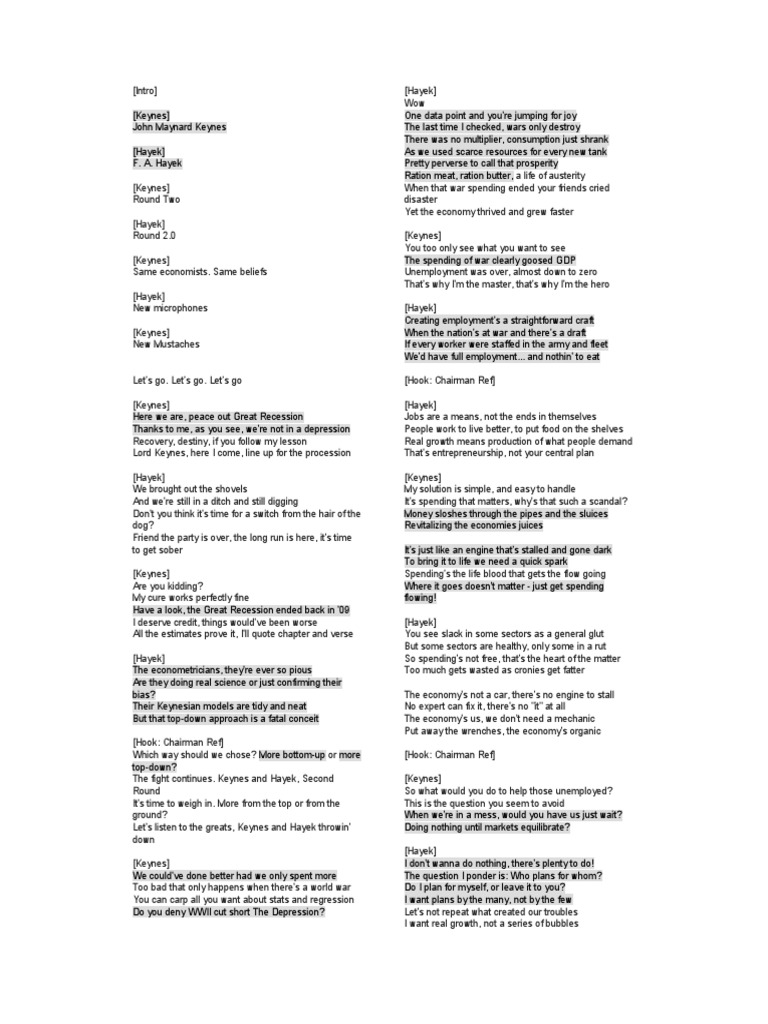
Can a debate about capitalism’s future be distilled into a clash between two towering intellects, each offering a radically different vision? In just five minutes, we can traverse the labyrinthine economic philosophies of John Maynard Keynes and Friedrich Hayek, whose discord on capitalism continues to influence contemporary discourse. Yet, what if the real challenge lies not in choosing sides, but in understanding the very dilemmas their ideas present? Let’s delve into the intellectual arena where Keynesian optimism collides with Hayekian caution, illuminating nuances that shape our economic realities.
The Philosophical Divergence: Intervention vs. Spontaneity
At the heart of the Keynes-Hayek debate lies a philosophical fork: should economies be steered actively by governments, or should they be allowed to evolve through spontaneous market forces? Keynes championed intervention, asserting that capitalism, if left unchecked, is inherently unstable. He argued that during downturns, markets often fail to self-correct swiftly, necessitating proactive fiscal policies. Government spending and monetary stimulus, in his view, were potent instruments to rekindle demand and restore employment.
Conversely, Hayek’s philosophy radiates a wary skepticism toward centralized control. He proposed that markets are complex, adaptive systems with information too dispersed for any authority to harness fully. Thus, attempts to micromanage the economy could backfire, distorting price signals and leading to malinvestment. Hayek exalted the “invisible hand” and cautioned that only unfettered competition can organically calibrate resource allocation, ensuring long-term prosperity.
Capitalism Under Strain: Stability or Spontaneous Order?
Keynes saw capitalism’s periodic crises as systemic flaws that threatened societal stability. Unemployment and recessions were not aberrations but endemic maladies requiring medical intervention—stimulative policies to jumpstart sluggish economies. He emphasized that during a slump, private sector demand collapses and cannot be remedied by laissez-faire alone, making public investment indispensable.
Hayek, conversely, embraced “spontaneous order” – the idea that decentralized decision-making inherently produces efficient outcomes. For him, economic cycles weren’t failures but natural adjustments to corrections in misallocated capital. Government interference, he warned, could prolong downturns, creating distortions rather than resolutions. The spontaneity of markets assures adaptability that rigid planning stifles; thus, crises are not excuses for intervention but signals to withdraw it.
On the Role of Knowledge: Central Planning’s Achilles’ Heel
A pivotal tenet in Hayek’s critique is the limitation of knowledge. He argued that information is decentralized, tacit, and constantly evolving, rendering central planners invariably ignorant of myriad local conditions. The price system, he insisted, is a vital messenger encoding this dispersed knowledge, guiding individuals’ economic decisions organically.
Keynes, however, accepted practical limitations within markets but viewed government expertise and data aggregation techniques as sufficiently capable of navigating complexities. His faith was less in the sanctity of market signals and more in pragmatic policymaking that interprets indicators and acts decisively to offset economic shortfalls.
Economic Freedom and Individual Autonomy
Economic freedom occupies contrasting spaces in their ideologies. Hayek elevated it as the linchpin of not only prosperity but also political liberty. Market freedom allowed individuals to pursue interests without coercive impositions, creating a pluralistic environment that fostered innovation and cultural progress. Restrictions, even with benign intentions, posed dangers of authoritarianism.
Keynes did not dismiss liberty but prioritized the alleviation of social distress and economic insecurity. His model envisioned a capitalism tempered by social safety nets and regulatory frameworks that protected workers and lessened inequality, securing freedom through fairness rather than pure market autonomy.
The Long-Term Vision: Growth, Equality, or Evolution?
Keynesian economics looks toward a managed capitalism where growth is sustained through cyclical adjustments driven by policy. Yet, underlying this was Keynes’ hope for a future where economic abundance would reduce work’s centrality in life, allowing greater cultural and intellectual pursuits. His ideal capitalism was not unfettered accumulation but a system assuaged of volatility, enabling human flourishing beyond mere economics.
Hayek’s long-term vision embraced capitalism as an evolutionary process. Rather than directed progress, capitalism’s success derived from continuous experimentation by individuals responding to market signals. Equality, in Hayek’s eyes, was not a precondition for freedom but an emergent, if often imperfect, consequence of competitive enterprises freeing human potential.
The Modern Dilemma: Can Keynes and Hayek’s Perspectives Coexist?
Here lies the playful question: Is the capitalist conundrum a binary battle, or a dynamic duality demanding both elemental truths? Policymakers grapple with when to intervene or abstain, reflecting Keynes’ practicality versus Hayek’s principled caution. The recent decades have witnessed oscillations between these poles—stimulus packages giving way to austerity, deregulation balancing with oversight.
The challenge intensifies amid globalization, technological disruption, and climate change—forces neither economist could have fully anticipated. Does Keynesian intervention risk fostering dependency or moral hazard? Or does Hayekian minimalism ignore the systemic risks threatening fragile populations? Neither paradigm offers a panacea, but together, they provoke a richer understanding of capitalism’s complexities.

