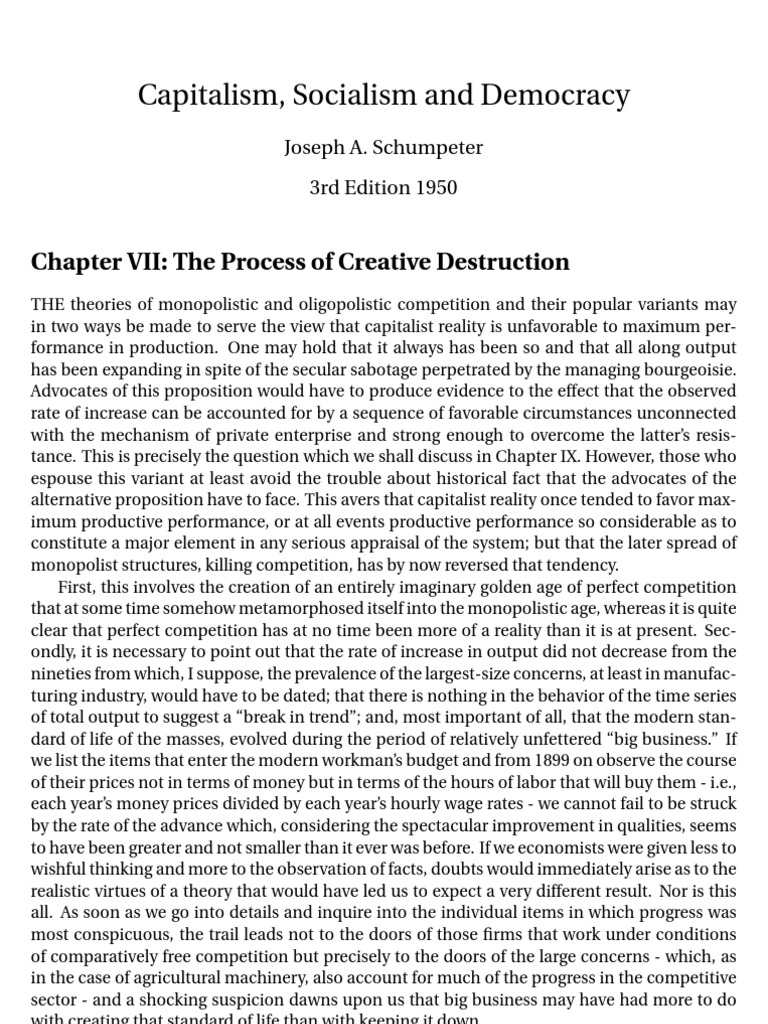
At the heart of economic transformation lies an intriguing paradox: progress is often fueled by the very forces that dismantle the old to make way for the new. This paradox is elegantly encapsulated in the concept of creative destruction, a phenomenon that not only redefines industries but also reshapes societies and propels innovation forward. Understanding this dynamic offers a profound shift in perspective—prompting us to question the nature of economic growth, the resilience of established systems, and the true cost of progress. Let us embark on a journey through the intricate mechanisms of creative destruction, unraveling its profound implications and the relentless pulse it imparts on the economy.
The Essence of Creative Destruction
Creative destruction is far from mere economic jargon; it is a powerful analytical lens through which we can observe how capitalism evolves. At its core, this concept describes the process by which new innovations shatter existing structures and usher in unprecedented modes of production and consumption. It is an inexorable force driving obsolescence while simultaneously sparking renewal. This cyclical upheaval is not a sporadic event but a continuous, self-reinforcing dynamic intrinsic to the capitalist system. Unlike stasis or gradual evolution, creative destruction implies that growth necessitates dismantling established paradigms, often abruptly and irreversibly.
Historical Context and Intellectual Genesis
The intellectual provenance of creative destruction traces back to a time when economic thought was grappling with reconciling technical innovation with the persistence of economic cycles. This concept emerged as a corrective to classical economic theories that emphasized equilibrium and incremental improvement. Instead, it highlighted the disruptive potential of entrepreneurial innovation. By foregrounding the entrepreneur not merely as a participant but as a catalytic agent of transformation, creative destruction foregrounds the vigorous, and at times destructive, nature of economic change. It frames innovation as a double-edged sword—capable of exhilarating progress and profound dislocation in equal measure.
Mechanics Behind the Transformation
The process of creative destruction unfolds in phases, each marked by distinct economic and social phenomena. Initially, an entrepreneurial breakthrough introduces a novel product, service, or process that challenges incumbent market players. Early entrants reap the benefits of monopoly-like profits, attracting capital and talent. As adoption spreads, legacy companies begin to feel the pressure, often faltering under the weight of their own inertia or inability to adapt. This phase is characterized by heightened competition, resource reallocation, and sometimes painful rationalization. Eventually, the market structure stabilizes, but at a new level of productivity and technological sophistication. This continual churn ensures that no industry remains unscathed by innovation’s relentless advance.
Economic and Social Implications
The ramifications of creative destruction ripple far beyond corporate boardrooms and stock markets. Economically, it injects vitality into stagnant sectors and fosters diversity in production. New firms emerge, sectors realign, and consumer choice expands. However, this process also brings volatility. Job displacement, industry decline, and regional economic distress are real consequences that challenge social cohesion. The tension between innovation-driven growth and short-term disruptions underlines the delicate balance policy must strike. Recognizing creative destruction as both a source of opportunity and uncertainty is crucial to framing responsive economic strategies that harness its benefits while mitigating its human costs.
Creative Destruction in the Modern Economy
In today’s hyper-connected, digital age, the cadence of creative destruction has accelerated dramatically. Technologies such as artificial intelligence, blockchain, and renewable energy are dismantling traditional sectors at a pace scarcely imaginable in prior eras. Entire business models—from retail to transportation—have been revolutionized, often leaving established incumbents struggling to pivot. The phenomenon now operates on a global scale, with innovations diffusing rapidly and cross-pollinating different industries. This heightened dynamism offers unparalleled potential for prosperity, yet also amplifies the challenges of disruption, making adaptability a sine qua non for survival.
Rethinking the Narrative: A Shift in Economic Perspective
Embracing the doctrine of creative destruction compels a fundamental reassessment of how we conceptualize economic progress. Rather than viewing disruption as a purely negative force to be resisted, this perspective invites a more nuanced understanding. It highlights that destruction is not gratuitous but a prerequisite for the emergence of superior systems and products. This shift challenges entrenched dogmas of preserving legacy industries at all costs and encourages policies that foster innovation, entrepreneurship, and resilience. It simultaneously underscores the ethical imperative to support those adversely affected—a recognition that the phoenix of creation inevitably casts shadows upon certain groups.
The Entrepreneurial Spirit as the Catalyst
Central to this inexorable process is the entrepreneur, whose vision and audacity ignite creative destruction. Entrepreneurs act as agents provocateurs within the economic system, introducing risk-bearing innovations that defy convention. Their role transcends the mere execution of ideas; it encompasses the reshaping of market structures and the disruption of accepted norms. Through their endeavors, the competitive landscape is continually redrawn, generating new opportunities and rendering obsolete the old. The entrepreneur embodies the dynamic tension between creation and annihilation that fuels the engine of capitalist progress.
Measuring Creative Destruction: Challenges and Insights
Quantifying the phenomenon poses significant difficulties. Traditional economic metrics often fail to capture the nuances of creative destruction, focusing instead on aggregate output or short-term employment figures. The transformative undercurrents—such as knowledge spillovers, intangible assets, or long-term productivity gains—are elusive and complex. Yet, advancing methodologies in economics and data science are beginning to illuminate these processes more vividly. Understanding how to measure and anticipate the waves of destruction and creation remains pivotal for economists and policymakers intent on fostering sustainable and inclusive economic development.
Conclusion: Embracing the Paradox of Progress
Creative destruction compels us to confront a paradox at the intersection of innovation and obsolescence. It is a process that promises progress while imposing upheaval—a relentless rhythm that both builds and dismantles. Recognizing this duality provides a richer, more realistic portrait of economic evolution. By appreciating the indispensable role of creative destruction, societies can better navigate the uncertainty of modernization, crafting frameworks that embrace change while cushioning its harsher impacts. This understanding offers not only an explanatory model but also a powerful call to embrace innovation with both courage and compassion.


