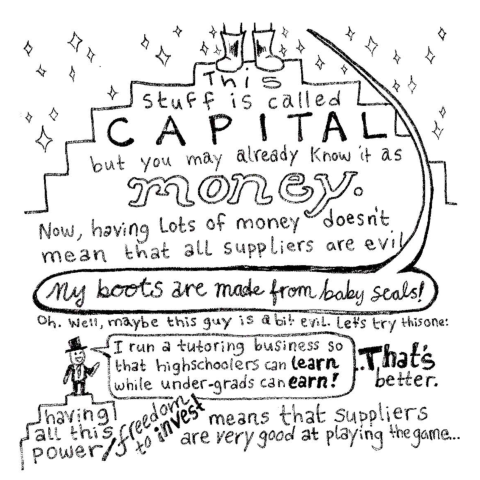
The financial labyrinth of our modern world is often navigated through the lens of “Weird Capitalism,” a term describing the idiosyncratic, sometimes baffling, and increasingly abstract manifestations of market logic in contemporary society. Understanding these quirks requires peeling back layers to reveal the fundamental dynamics driving this engine of unprecedented wealth creation and distribution—and, conversely, its often unsettling side effects.
Cosmic Coincidences and Serendipitous Structures
In its pure form, capitalism aspires to unfettered exchange based on individual ownership and the pursuit of profit. Yet, the reality we inhabit is a complex tapestry woven with threads of immense human ingenuity, unforeseen technological serendipities, and institutional frameworks born of historical necessity. What emerged wasn’t a static construct but rather a dynamic, self-referential feedback system – a perpetually recalibrating engine fueled by innovation and risk, operating like a cosmic junkyard where disparate pieces coalesce into functional, albeit sometimes bizarre, structures.
The Turbine of Innovation and Asset Appreciation
A prime example lies in the proliferation of intangible assets. Capitalism developed mechanisms – patents, stock markets, complex financial instruments like derivatives – that allowed value to be extracted from ideas, brands, and future potential long before any physical product materialized. This became a powerful (if dangerous) turbine, incentivizing innovation through the promise of capturing value far down the line. Think of a software startup valued in the billions based not on current revenue, but on projected market dominance and future exit potential – the engine room of speculative growth.
Fabric of Regulation and Rhetoric: The Necessary Contraption
Detailed regulations form the essential underpinning of modern capital markets, sometimes creating elaborate bureaucratic contraptions just to manage the system itself. Consider the labyrinthine rules governing derivatives trading – designed to track and limit risk in complex financial contracts that interact in ways their creators likely never anticipated. This intricate “risk management” apparatus often mirrors the very complexity it seeks to control, operating at a remove that can obscure the fundamental mechanics. Similarly, accounting standards for intangible assets, such: *pension liabilities that represent unfunded promises, *brand valuations often based on subjective goodwill, *intangible IP value. These require bespoke rules, creating a secondary market where the worth is derived not just from the asset itself, but from its representation.
Looming Paradoxes: Scarcity in a Data Age
Perhaps one of capitalism’s most enduringly “weird” paradoxes is the tension between scarcity and abundance. In physical market capitalism, scarcity is often a brake – governing distribution, quality control, and pricing. Competition, after all, operates around limited resources. Yet, our digital epoch increasingly values assets whose core scarcity is manufactured or illusory. Ownership of a data point is meaningless without the right to its use; distribution itself becomes a core component of value, transforming traditional supply constraints into new forms of potential abundance.
The Aesthetics of Absurdity: High Finance Visualized
The weirdness finds a poignant visual analogue in the abstract design of modern finance or the often surreal, functional architecture of institutions built to manage unprecedented scale and complexity. Just as a bespoke machine might feature non-standard interfaces for monitoring an internal combustion engine’s minute fluctuations, or where ergonomic principles give way to peculiar requirements in control-room design, certain facets of modern finance possess their own peculiar logic. A graphical representation might use esoteric symbols or display crucial metrics in unconventional ways, revealing an internal logic that seems detached from everyday reality.
The Allure of the Mysterious Engine Room
The fascination with “Weird Capitalism” resides partly in its opacity. These complex systems operate with vast inputs and outputs against which common sense often fails to provide meaningful leverage. This inherent strangeness breeds a powerful allure akin to peering into a functional engine room – one whose operation, even with detailed schematics, remains deeply counterintuitive. The appreciation, therefore, is often less about comprehension and more about observing the system itself, recognizing that value can emerge from complex, unpredictable feedback loops.
Beyond the Glare: Looking at Weird Capitalism
Ultimately, navigating, understanding, or even appreciating Weird Capitalism requires stepping back from conventional models of economy and value. It demands embracing the strange, often disorienting, logic that underpins our intricate system. It requires developing a fluency not just in economics, but in understanding the bespoke machinery of the modern age – a system that, despite its inherent weirdness, continues to drive unimaginable creativity and wealth generation.

