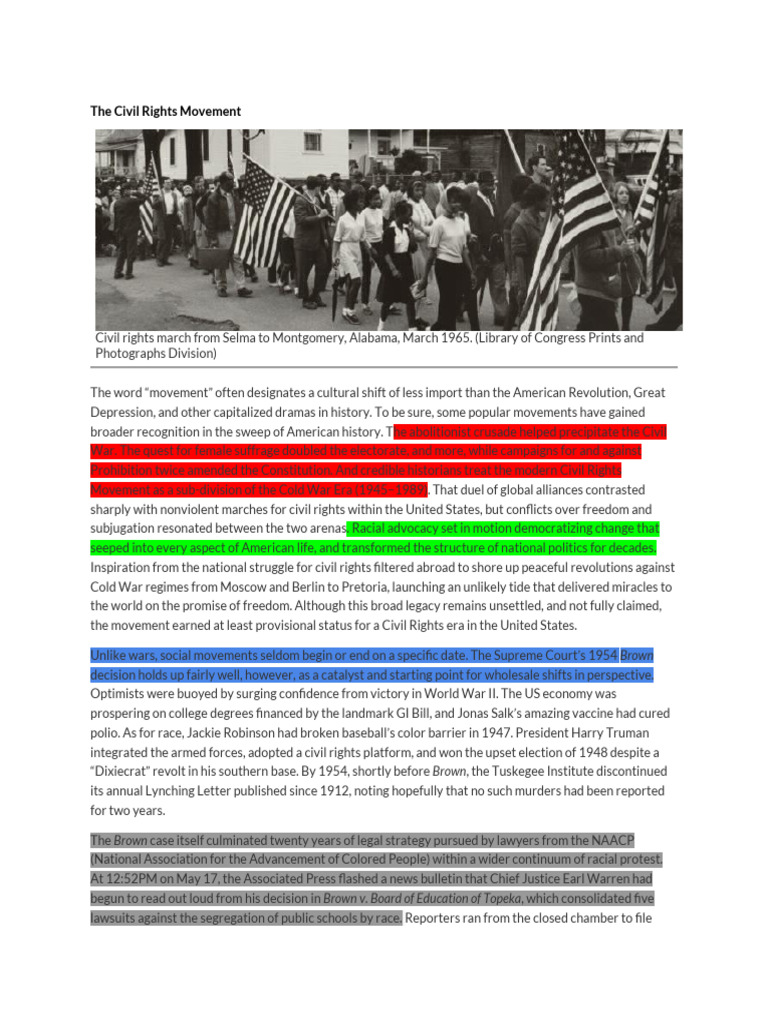
The Civil Rights Movement is commonly hailed as a pivotal struggle for equality and justice, an unequivocal battle against systemic racism and segregation. Yet, a growing discourse suggests that this transformative chapter in American history can also be perceived through the lens of capitalist reform. This perspective challenges the conventional narrative by positing that the movement, in addition to its undeniable moral imperatives, operated as a mechanism to recalibrate economic hierarchies and stabilize capitalist social orders. This notion piques fascination because it calls attention to the multifaceted forces propelling social change and the subtle interplay between justice and economic interests.
The Civil Rights Movement: More Than a Quest for Social Justice
At the heart of the Civil Rights Movement lay a fundamental desire for equality and dignified treatment under the law. The movement’s emblematic demands—voting rights, desegregation, and economic opportunity—swiftly transcended mere social reform. These demands implicitly critiqued entrenched inequalities that were not only racial but also economic in nature. The fight against Jim Crow laws was simultaneously a push against socio-economic stratification that hindered African Americans’ integration into the broader capitalist economy.
This dual aspect—a fight for civil liberties and economic empowerment—suggests that the Civil Rights Movement was, in some respects, a reshaping of the capitalist framework to better incorporate marginalized populations. By securing legal rights, the movement set the stage for broader participation in the market economy, thereby addressing the instability that racial exclusion imposed on capitalist growth.
Capitalism and the Necessity of Social Stability
Capitalism, as an economic system, thrives on conditions of relative social stability and predictable market behavior. Chronic racial discrimination and disenfranchisement threatened the legitimacy and efficiency of the capitalist order by creating vast segments of the population who were disenfranchised consumers and workers. The Civil Rights Movement can be interpreted as a pressure valve that alleviated this tension, making systemic reforms to secure a more inclusionary economic base.
This perspective paints the movement as a form of capitalist reform—a necessary adjustment that preempted potential upheaval. By offering procedural avenues for African Americans to claim rights and economic participation, it mollified social unrest and opened new channels for capital accumulation. The swelling middle class within Black communities post-movement is a testament to how civil rights reforms catalyzed new markets and labor demographics, hence invigorating capitalist dynamics.
The Role of Government and Corporate Interests
An exploration of this capitalist reform thesis cannot ignore the roles played by governmental agencies and corporate entities during the movement. The federal government’s interventions, such as the Civil Rights Act of 1964 and the Voting Rights Act of 1965, were not mere altruistic gestures; they also reflected a strategic interest in maintaining domestic order and economic vitality during a tumultuous period marked by ideological Cold War competition.
Simultaneously, emerging corporate recognition of the African American market signaled a pragmatic recalibration. Businesses began to see the purchasing power of Black consumers and the importance of diverse labor forces. In this dynamic, capitalist interests found alignment with civil rights objectives, creating a symbiotic relationship in which social reforms dovetailed with profit motives. Far from being adversaries, economic elites often pragmatically supported select reforms that promised to expand capitalism’s reach.
Economic Integration as a Form of Inclusion
The Civil Rights Movement’s successes in education, employment, and housing were not solely about moral justice—they were also about harnessing the productivity and consumption potential of an entire demographic previously marginalized. Economic integration functioned as a form of social inclusion designed, in part, to sustain capitalist expansion by broadening the consumer base and labor pool.
The movement prompted landmark legislation that prohibited discriminatory hiring and housing practices, thereby opening new avenues for African Americans to engage within capitalist markets as producers, consumers, and entrepreneurs. This reshaped not only the social landscape but also the economic infrastructure, enabling a more diversified and ostensibly equitable market system.
Deeper Reasons Behind the Fascination with This Interpretation
Why does framing the Civil Rights Movement as capitalist reform captivate scholars and observers alike? The answer lies in its capacity to unsettle simplified narratives of history. It challenges us to reckon with how social justice achievements are often entwined with broader economic imperatives and power structures.
This interpretation insists that progressive social movements do not unfold in isolation. Instead, they are embedded within intricate matrices of political economy where moral and market interests can coincide, conflict, or coalesce. It invites a prism of analysis where the fight for equality is not only a story of righteous rebellion but also a saga of systemic adaptation and self-preservation by capitalist institutions.
The Legacy and Limits of Capitalist Reform in Civil Rights
While the capitalistic reframing highlights important dimensions of the movement’s strategies and outcomes, it also exposes inherent limitations. Economic integration achieved through civil rights legislation did not eliminate structural inequalities or eradicate racial capitalism’s foundational tensions. Persistent wealth gaps, residential segregation, and employment disparities remain tightly woven into the fabric of American capitalism.
The movement’s reformist achievements often constrained themselves within the boundaries of the existing system, which by design privileges capital accumulation. Thus, the narrative of the Civil Rights Movement as capitalist reform is complex: it acknowledges progress while recognizing the enduring contradictions of racial and economic justice within a capitalist society.
Conclusion: A Multidimensional Understanding of Social Change
Viewing the Civil Rights Movement as a form of capitalist reform compels a more nuanced understanding of history and social transformation. It suggests that profound social justice initiatives can simultaneously be strategies of systemic recalibration to preserve and advance economic hegemony. Such a framing adds rich complexity to the story, encouraging critical reflection on the forces and interests that shape societal progress.
This perspective does not diminish the heroic struggles or ethical imperatives of the movement but illuminates the multiple strata through which change operates. The Civil Rights Movement, thus, emerges as both a beacon of moral courage and a pivotal moment of capitalist adaptation—two dimensions forever intertwined in the unfolding narrative of American democracy.

