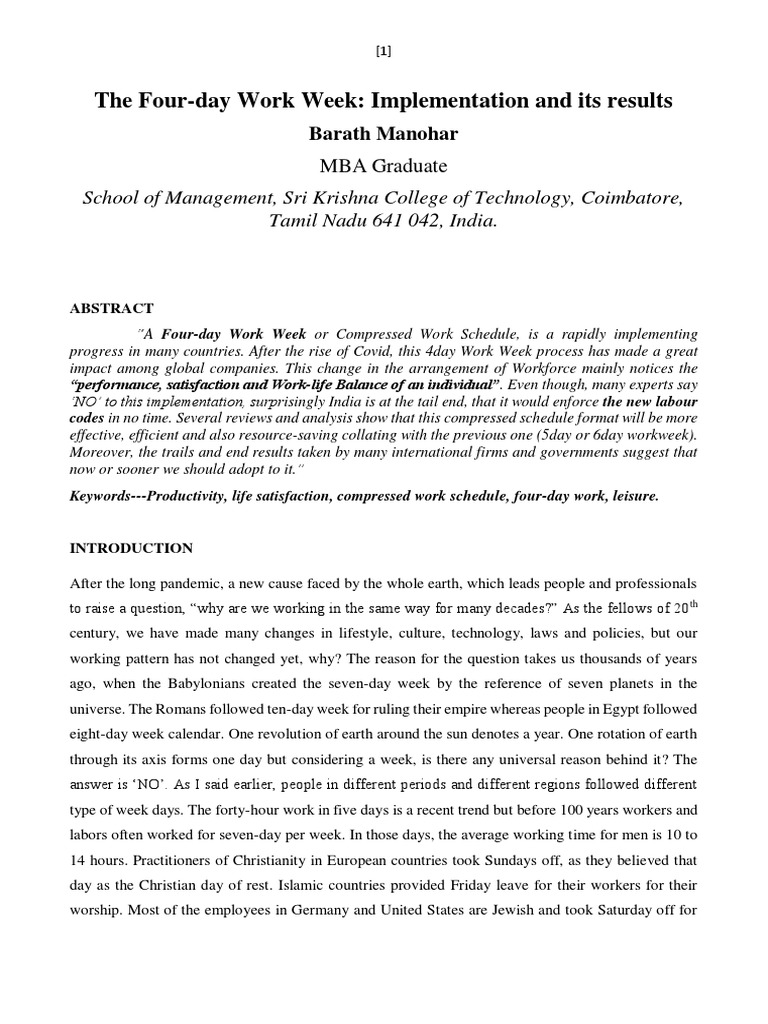
The prospect of the four-day work week within the framework of capitalism presents a conundrum of profound elegance. On one hand, it whispers of liberation, offering potential relief from the relentless grind historically demanded by industrial and post-industrial societies. This reduced work week, if implemented, could fundamentally alter the rhythm of economic life as participants know it. Yet, capitalism, by its very nature centered on profit accumulation, labor commodification, and continuous expansion, casts a shadow. Can a system predicated on intensive exploitation and maximal output, at least in theory, truly embrace the reduction of necessary labor time? This exploration delves into the intricate dance between the four-day week and the capitalist engine, dissecting the possibilities, contradictions, and inherent tensions.
Redefining Work Time and Its Economic Viability
In a capitalist economy, work time directly translates to available labor for production, wages to be paid, and surplus value potential for capital accumulation. The traditional five-day, Monday-to-Friday, 35-40 hour week emerged not merely from social agreement but from the rhythm of industrial production and the need to maximize capital control over human labor power. Implementing a four-day week necessitates a redefinition of this core relationship. Could market viability, driven by capitalist imperatives, exist with significantly shortened workweeks?
The Economic Viability and Redistribution Puzzle
At its foundation lies a redistribution of time. Companies trialing the four-day week absorb the freed-up day per week into existing operations or into savings. Some propose using it by having employees work longer hours on fewer days, aiming for equivalent output but reducing operational costs and burnout. Others genuinely shorten hours across the board, requiring either increased labor productivity or offsetting cost adjustments elsewhere within the business. The challenge for capitalism is scaling this redistribution. Achieving widespread adoption necessitates a collective reduction in labor hours, which initially requires surplus absorbed productivity to be allocated elsewhere, whether through innovation, reduced overhead, new product/services development, or—ironically—through wage reductions for those not participating in the trial (e.g., part-time workers), thereby threatening social equilibrium. It puts onus on capital to optimize efficiency, not just cut hours, creating a complex balancing act between worker well-being and profit targets.
Worker Autonomy, Resistance, and Class Conflict
Critically, the four-day week can be reframed less as a concession from capital than as a partial reorganization and partial assertion of worker power. By voluntarily adopting shorter hours (without necessarily immediately reducing wages proportionally for trials), employers signal a potential shift. However, this power dynamic is inherently fragile. Capitalist enterprises ultimately exist to be profitable. Voluntary abatement cannot be sustained if it encroaches upon profitability. Workers may experience increased autonomy through better balance, reduced stress, and greater leisure, representing a significant improvement in living standards. This improved standard of living inevitably creates a larger consumer market, potentially amplifying demand for goods and services, which appears positive. Yet, this benefit primarily accrues to employed workers while a vast majority remain outside or partially outside the labor force. Does capital’s control over job opportunities constrain this positive outcome for all? Furthermore, the trials themselves often face resistance within companies, requiring management buy-in and operational adaptability, highlighting the existing tensions within the capitalist workplace.
Productivity, Efficiency, and the Capitalist Imperative
The promise of the four-day week hinges significantly on increased productivity – either by intensifying work during the shorter week or through efficiency gains enabled by reduced hours. Capitalism thrives on optimizing labor, seeking ways to extract maximum product with minimum expenditure. Reduced work hours mean that the remaining hours must become more valuable per hour. This pressures companies to invest in technology, streamline processes, empower workers, and increase focus leading potentially to genuine long-term gains. However, without sufficient investment (capital), it struggles. Is increased productivity the natural result, or does the shortened week merely slow down expansion elsewhere? Capitalism’s relentless drive for more growth, ever higher returns, sometimes seems opposed to the stability offered by a balanced work week unless that stability translates directly into increased profits.
Impact on Innovation, Consumption, and Uneven Development
The freed time and improved well-being generated by a four-day week could foster innovation not just in the workplace, but in the broader society. Imagine employees with renewed energy and cognitive function; potentially increased innovation, creativity, and better problem-solving across industries. Freed time allows for more personal and community investment, potentially altering long-term consumption patterns. Capitalism’s success in innovation might see a boost, while its consumer market could be transformed sustainably. However, capitalism exhibits uneven development. Not all sectors benefit equally, and not all employers have the luxury or the incentive to experiment. Adoption is uneven, often occurring within companies already in strong positions or in specific, often white-collar, roles. This creates artificial divides, further entrenching existing inequalities and demonstrating the inherently selective nature of capitalist progress.
Looking Beyond the Workweek: Automation and De-growth
Could the four-day week be seen as capitalism reaching its physical limit, optimizing the human work component to its maximum sustainable point for worker health and society? As technology advances, particularly automation and artificial intelligence, the role of human labor may evolve further. Maybe automation allows for output with fewer standard hours, making the four-day week even more feasible or representing a different kind of optimization. Considering a four-day week *within* capitalism is one path, but its long-term viability might be intertwined with the trajectory of technology itself – including automation replacing labor. Furthermore, the debate touches upon de-growth critiques, questioning whether endless growth is necessary under *any* system, suggesting a reduction in the *pace* of capitalist (or any) development could benefit sustainable society.
Conclusion: Transformation or Managed Revolution?
The four-day work week within capitalism exists in a space between genuine liberation and systemic accommodation. It is simultaneously an imaginative leap, an economic experiment, a flicker of hope, and a potentially profitable adaptation by forward-thinking enterprises. It pushes the boundaries of capital’s logic regarding time, efficiency, and balance. Success at scale requires capitalism not only to function with reduced labor input but to re-valorize that time and energy effectively. It signals a significant shift in consciousness for participating workers, an undeniable alteration in the rhythm of work-life integration. Yet, the inherent contradictions remain stark. Capitalism’s drive for surplus value, its hierarchical structures, its uneven development, and its historical trajectory continually cast a long shadow over the feasibility and sustainability of such widespread change purely within its established boundaries. The four-day week is a notable anomaly, perhaps a harbinger of things to come, but its full implications and ultimate outcome within the structure of capitalism remain complex, contested, and far from guaranteed.


