The Vatican’s position on capitalism is a significant and evolving part of its social teaching. Rooted deep within the Latin Church’s rich theological and philosophical tradition, this perspective critically engages with the concept of private possession and market economies, offering a profound framework for understanding the moral dimensions of economic life. It’s an exploration of justice, human dignity, and the ordering of material things within society.
The Historical Context: Social Encyclicals
The Catholic Church’s engagement with socio-economic issues culminated in what are known as its “Social Encyclicals.” Beginning with Pope Leo XIII’s landmark 1891 encyclical “Rerum Novarum” concerning labor conditions and private property, a sequence of papal documents addressed modern industrial society. “Quadragesimo Anno” (1931), issued by Pope Pius XII, further developed Leo’s points, tackling socialism, syndicalism, and the State’s role. This theological lineage provides the backdrop for the current Magisterium’s stance on capitalism. Each papal teaching builds upon its predecessors, integrating insights from thinkers like the Doctor of the Church, St. John Henry Cardinal Newman, and addressing contemporary challenges.
Core Principles and Critique
The core of Catholic social teaching critiques capitalism not necessarily as an absolute system, but certain modern interpretations and unregulated forms that can subvert human dignity. Central to this critique is the concept of distributive justice, emphasized notably in Pope Francis’ encyclical “Evangelii Gaudium”. This calls for systems where wealth generated by labor and resources is distributed widely and equitably among the entire community. The Church also highlights that ownership rights (private property) exist not as an absolute end, but as a means – instruments for human flourishing and societal contribution. The distinction between ownership and dominion (control, or “usus”) is a crucial theological thread; untrammeled dominion can lead to the commodification of humanity and creation itself.
Condemning Unregulated Capitalism
Specific papal encyclicals, especially those reflecting upon the failures and excesses exposed by the 2008 financial crisis, paint a critical picture of unrestrained finance, speculative bubbles, predatory practices, and excessive profit extraction that compromises the common good. Pope Francis’ “Ordinatio Sapientiae” (“The Economics of the Patriarch”) explicitly uses the term “capitalism” to describe systems characterized by short-term profit motives, exploitation, environmental degradation, disregard for labor rights, and financial speculation. The encyclical draws upon Scripture and Tradition to critique these tendencies, emphasizing an “economy of communion” or an “economy of gift” focused on human flourishing.
A “Different” Way – The “Middle Way”
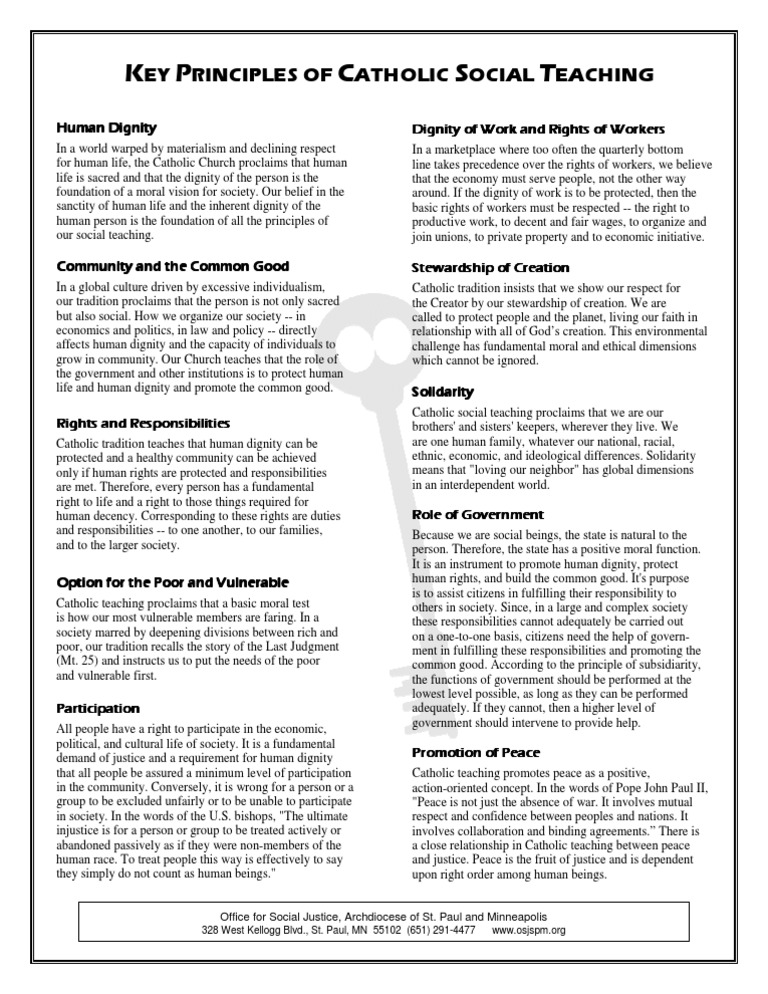
The most distinctive aspect of the Papacy’s current stance, particularly articulated in “Caritas in Veritate” (2009) by Benedict XVI and echoed by Francis, is the emphasis on what might be termed the ‘social option’ or the ‘middle way’. This proposes an economic system based upon solidarity, subsidiarity, and market mechanisms that are socially oriented and genuinely democratic. This vision favors systems where the central tenets of Catholicism – respect for human dignity, concern for justice, solidarity between persons, and integral human development – are actually embedded within the structures of the economy. Markets should serve human needs through “universal destination of goods” and regulated ownership should prioritize the common good.
Dignity of the Worker
Perhaps one of the most consistent pillars is the dignity of labor, lauded in"Laborem Exerce", especially when one is paid a just wage (a living wage covering necessities) and has fundamental rights at work. The emphasis on the inherent human dignity within the workforce underpins much of the critique of exploitative labor practices. Unionization is often recommended as the worker’s primary means of achieving justice with the employer.
Capitalism and Social Entrepreneurship
Interestingly, the Vatican also recognizes the potential for constructive action from certain forms of market engagement, distinguishing what might be termed “social” and “truly private” appropriation of wealth. This is perhaps closest to the concept of Trinitarian economics. Pope Francis explicitly encourages forms of social entrepreneurship, enterprises whose principal aim is service to the common good, providing social support, environmental regeneration, or community building, yet achieving profitability in a way that aligns with their mission, sometimes termed “B Corporations”. This represents a qualified nod towards market-based solutions when appropriately structured.
Conclusion: A Call for Dialogue
The Vatican’s social teaching does not offer simplistic condemnations or endorsements of the free market. It presents a robust framework demanding continuous vigilance against the subtle dehumanizing forces of unregulated capitalism. The Holy See advocates for an economy restructured around human needs, social justice, and integral human development. Its position actively calls for dialogue between Catholics, policymakers, and the global community to foster an economic order that reflects Gospel values – integral humanism, solidarity, subsidiarity, labor rights, and the universal destination of creation’s goods. This is not merely a critique from afar, but an invitation to constructively engage the realities of market economies, ensuring they ultimately serve human dignity above and beyond profit or accumulation.

