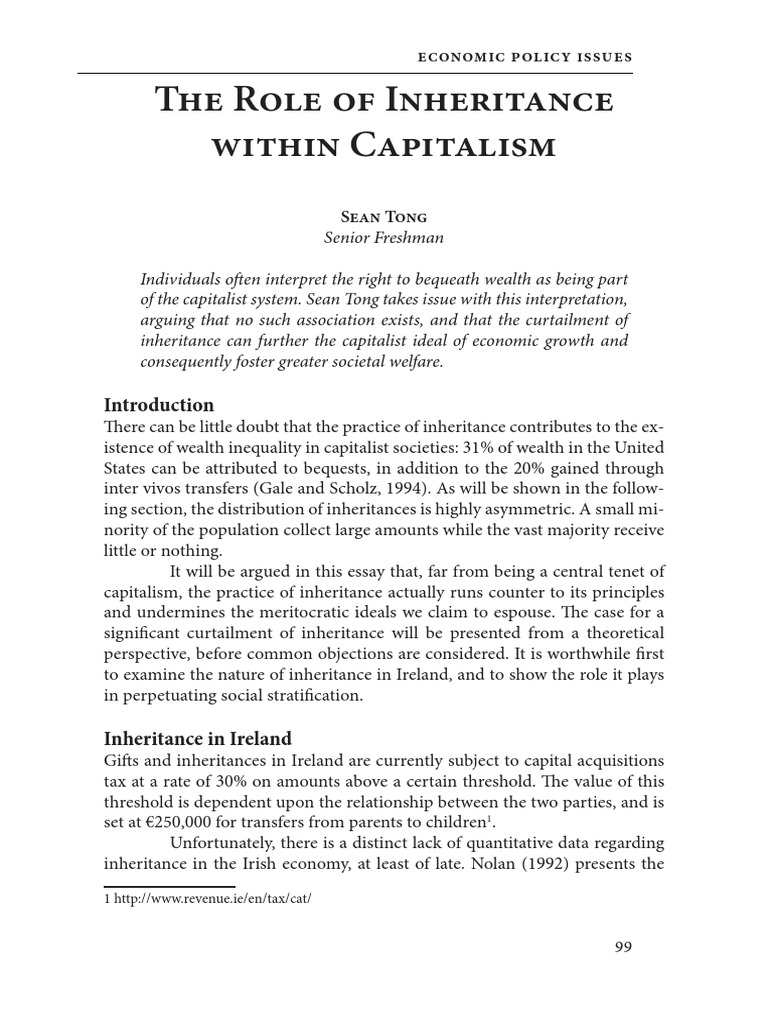
Imagine capitalism as a vast, intricate clockwork—a system where each cog, from individual labor to entrepreneurial spirit, meshes to propel economic growth. Inheritance, within this machinery, functions like a transfer of momentum, a handoff of previously accumulated energy allowing the next generation’s gears to begin turning not from a standstill but with a burst of speed. But what if this handoff were removed? What if inheritance, the bequeathing of wealth and assets across generations, were suddenly forbidden? Such a scenario would disrupt the clockwork’s rhythm, triggering profound ripples throughout the economic landscape and societal fabric. Examining the implications of banning inheritance under capitalism unveils a multifaceted narrative about fairness, motivation, wealth distribution, and the very essence of legacy.
The Genesis of Economic Equality: Flattening the Starting Line
In a world where inheritance is banned, the economic playing field would undergo a fundamental leveling. Wealth would no longer cascade through family lines like a perennial river nourishing fertile grounds. Instead, each individual would emerge into the world with their own distinct reservoir, no different from their neighbor. This metaphorical soil, devoid of inherited richness, would compel society to rethink the essence of opportunity. The advantage of being born into affluence—which acts as a catapult to educational excellence, health access, and social capital—would evaporate, potentially giving rise to a purer meritocracy. The race for success would begin uniformly, each runner starting at the same line rather than staggered by inherited head starts.
Yet, beneath this idealistic veneer lies complexity. Access to wealth is not merely financial but is intertwined with knowledge, networks, and the subtle influence of generational upbringing. While banning inheritance could strip away overt financial advantages, ingrained cultural capital might persist, making “equal starts” more theoretical than actual. Nonetheless, the very act of prohibition would symbolize a societal pivot towards emphasizing individual endeavor over familial privilege.
Incentives and Innovation: Fuel or Friction?
Inheritance under capitalism often serves as a double-edged sword. On the one hand, it can spur innovation—entrepreneurs and inventors are incentivized to create fortunes for their descendants, striving to build empires that can be passed down as living legacies. On the other hand, guaranteed wealth transfer may dampen motivation for heirs, substituting inherited affluence for personal ambition and enterprise.
Banning inheritance could recalibrate these incentives dramatically. Entrepreneurs might be propelled by more immediate rewards rather than distant promises to their progeny. The mansion left to future generations would morph into a monument not of heritage, but of self-made accomplishment, decoupling long-term family wealth accumulation from entrepreneurial drive. This shift might galvanize a culture where success is measured by one’s own tenacity and vision, potent engines under capitalism.
However, it could equally result in diminishing long-term investments that rely on family stewardship across generations—like sustained philanthropy, community development, or stewardship of founding enterprises—which inherently require trust in the continuity of wealth. The eradication of inheritance might induce a cultural contraction, pruning the deep-rooted patience necessary for certain ambitious economic undertakings.
Wealth Redistribution Dynamics: The Cascading Effects
Without inheritance, the fate of wealth accumulated by individuals becomes a critical question. Does all wealth revert to the state upon death or is it redistributed through alternative mechanisms? The redistribution pathway inevitably rewrites fiscal policies and social contracts. For instance, wealth rechanneling could serve as a powerful instrument to alleviate inequality.
This influx could fortify public goods—healthcare, education, infrastructure—reconfiguring capitalism into a system more responsive to collective welfare than private legacy. The economy might witness a cyclical redistribution of capital, akin to a tide that rebalances shorelines rather than allowing sandcastles to endure untouched for generations. Such a model, in theory, nurtures social mobility and mitigates wealth entrenchment.
Conversely, the redistribution process itself could be vulnerable to bureaucratic inefficiencies and political manipulation. Furthermore, it risks disincentivizing wealth creation if capital accumulation is perceived as fleeting rather than generational. The paradox is clear: while the abolition of inheritance could democratize wealth in one sense, it might simultaneously strain the capitalist propulsion driven by private ownership incentives.
Legacy and Identity: Beyond Material Wealth
Inheritance transcends mere dollars and property—it is a vessel of identity, culture, and familial narrative. When no material legacy is passed down, families must seek alternative modes of perpetuating memory and values. This shift invites a richer dialogue on what constitutes true inheritance.
Stories, traditions, and ethical compasses might gain newfound prominence as the “wealth” that defines subsequent generations. A society that forbids material inheritance could elevate intangible assets like education, mentorship, and social capital as the pillars of legacy. This redefinition challenges the capitalist paradigm heavily focused on accumulation, nudging it towards a more holistic appreciation of human capital.
Yet, the absence of material inheritance could provoke existential anxieties. The desire to leave a mark—a tangible imprint that signals one’s passage through time—might find itself frustrated in a system that disrupts conventional mechanisms of wealth transmission. Navigating this tension would be a crucial cultural evolution accompanying any ban on inheritance.
Legal and Practical Challenges: Enforcement in a Complex Economy
Proscribing inheritance would demand a labyrinth of legal reforms and vigilant enforcement mechanisms. Wealth often hides behind trusts, offshore accounts, and other financial instruments designed precisely to circumvent taxes and controls. The practicalities of banning inheritance entail not just legislative clarity but also technological sophistication and international cooperation to prevent capital flight and evasion.
Moreover, the moral dimensions of such legislation would provoke significant debate. Is forbidding inheritance an unjust intrusion on personal freedom and property rights? Could it drive wealthy families to relocate, starving the domestic economy of capital and the philanthropy it often fuels?
The legal infrastructure would have to reconcile competing interests—individual liberty, social equity, and economic vitality—crafting a delicate framework that withstands both practical challenges and philosophical contests.
The Future of Capitalism: Adaptation or Revolution?
Ultimately, banning inheritance would act as a catalyst forcing capitalism to confront its own contradictions. Capitalism thrives on private ownership and accumulation, yet unchecked inheritance risks ossifying social hierarchies and stalling innovation. Removing inheritance demands reimagining capitalism’s foundational principles.
Such an upheaval may give rise to hybrid systems—capitalism infused with stronger social safety nets, or models with progressive wealth cycling mechanisms. It may inspire novel institutions that balance personal wealth creation with collective economic regeneration. The experiment would test capitalism’s resilience and capacity to evolve beyond merely the accumulation of capital to fostering equitable opportunity and dynamic growth.
The clockwork may need to be rewired, but the gears could yet turn with renewed vigor, driven by fresh forces—individual merit, societal fairness, and innovative enterprise unshackled from inherited privilege.

