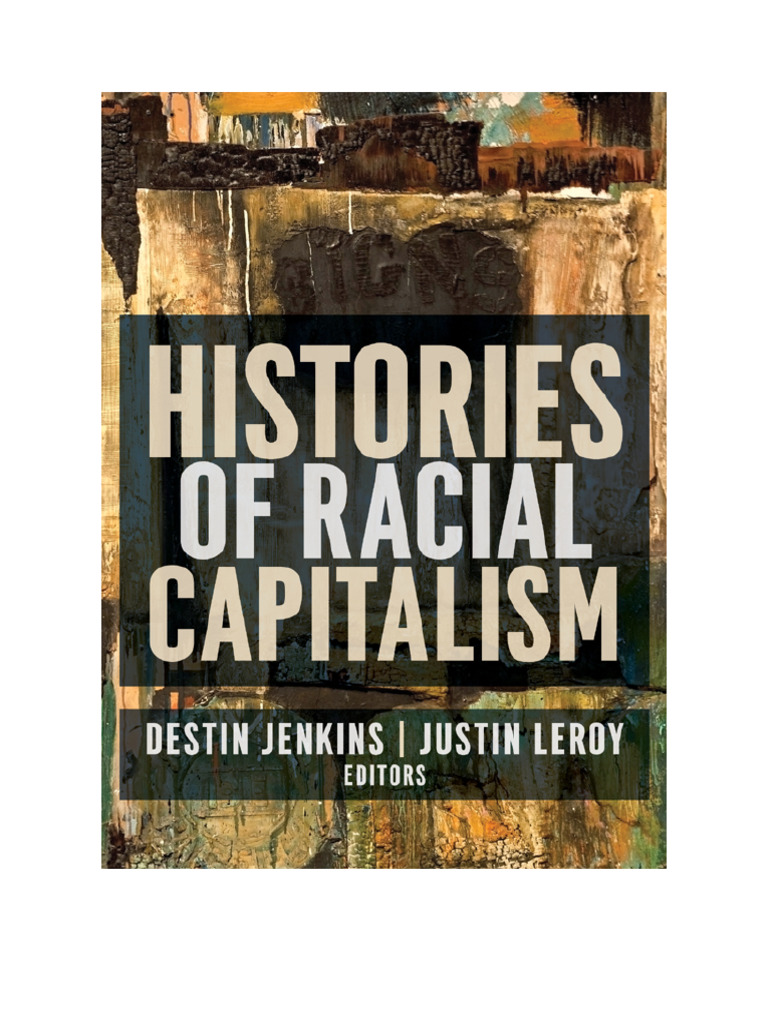
What if the very system that promises economic freedom and equality is also the engine driving racial inequality? Can capitalism, often heralded as the ultimate equalizer, simultaneously perpetuate racial hierarchies? These questions lead us directly into the complex and provocative concept of racial capitalism—a framework that challenges conventional understandings of both race and economy in deeply unsettling yet enlightening ways.
Unveiling Racial Capitalism: A Confluence of Race and Economy
At its core, racial capitalism is the notion that racial exploitation and economic accumulation are not separate phenomena but intertwined mechanisms. In other words, profits and economic development have historically depended on racialized labor and the systematic marginalization of certain groups. This concept unearths the paradox within capitalism: while capitalism thrives on competition, innovation, and the so-called free market, it simultaneously sustains rigid racial divisions that determine who benefits and who is exploited. The term calls attention to the fact that racial disparities are embedded into the very fabric of economic systems.
The Historical Tapestry: Origins and Evolution of Racial Capitalism
The historical backdrop of racial capitalism is etched with the scars of colonialism, slavery, and segregation. It harks back to the transatlantic slave trade, where the commodification of Black bodies laid the groundwork for vast economic fortunes in Europe and the Americas. Far from being an aberration, racialized labor underpinned the rise of modern capitalism. Plantation economies, resource extraction in colonized lands, and the racialized division of labor throughout the industrial era demonstrate how racial subjugation was instrumental in wealth generation.
As systems evolved, so did the methods of racial capitalism. Post-slavery, mechanisms such as sharecropping, Jim Crow laws, redlining, and mass incarceration emerged—each reinforcing racial disparities while facilitating capital accumulation at the expense of marginalized communities. This ongoing historical lineage shows that racial capitalism is neither a relic nor a coincidence but a persistent structure continuously adapting to maintain racial-economic hierarchies.
How Racial Capitalism Functions in Contemporary Society
One might wonder, “Isn’t modern capitalism colorblind and meritocratic?” Racial capitalism challenges this myth by highlighting how economic practices and policies today still operate through racialized structures. From wage gaps and job segregation to unequal access to credit and housing markets, the evidences are robust. Corporate strategies, global supply chains, and labor markets often exploit racialized populations—both domestically and internationally—to maximize profits.
Beyond employment, consumer culture contributes to racial capitalism through targeted marketing and the commodification of cultural identities. Additionally, environmental racism—where marginalized racial groups disproportionately suffer the consequences of pollution and climate change—reveals how capitalist appetites extend to the exploitation of bodies and environments deemed expendable. In this way, racial capitalism persists as a multifaceted phenomenon that saturates economic activities.
Theoretical Foundations and Critical Thinkers
Racial capitalism is deeply rooted in critical theory and social analysis. The term gained prominence through scholars who sought to unravel the connections between systemic racism and economic power. Cedric Robinson’s groundbreaking work posited that capitalism cannot be understood without considering its racialized foundations, arguing that capitalism developed within a “racial capitalist” framework rather than existing separately from racial domination.
Subsequent thinkers have expanded this analysis to interrogate how race functions as a social construct that capitalism exploits to create hierarchies and justify exploitation. This intellectual tradition equips us with lenses to decode not only past injustices but also the subtle, structural inequalities baked into present-day institutions.
Why Racial Capitalism Matters: The Practical Implications
Understanding racial capitalism is not merely an academic pursuit; it offers critical insights for activists, policymakers, and anyone invested in social justice. Recognizing that economic inequality and racial injustice are intertwined challenges isolated approaches to reform. Strategies that fail to consider racial capitalism risk reinforcing the very systems they intend to dismantle.
This conception encourages holistic change—combining economic redistribution with racial equity initiatives. It also invites a reimagining of capitalism itself: Can a system premised on exploitation be truly reformed, or is a radical transformation necessary? Grappling with racial capitalism pushes us to confront uncomfortable truths and to envision alternative futures where economic and racial justice move hand in hand.
Engaging with Racial Capitalism: A Call to Curiosity
So, after just a few minutes exploring the terrain, the challenge emerges: How do we take what seems like a complex, daunting concept and apply it to our daily realities? How might awareness of racial capitalism reshape the way we think about jobs, neighborhoods, education, or even the products we consume? Rather than viewing capitalism as a monolith or racial injustice as a side issue, embracing the complexity allows for richer discussions and more effective action.
By asking playful yet profound questions—What profits from division? Who benefits from inequality?—we open doors to critical inquiry and imaginative solutions. Racial capitalism is not a puzzle with a simple answer; it is a mirror reflecting the contradictions of the world around us.

