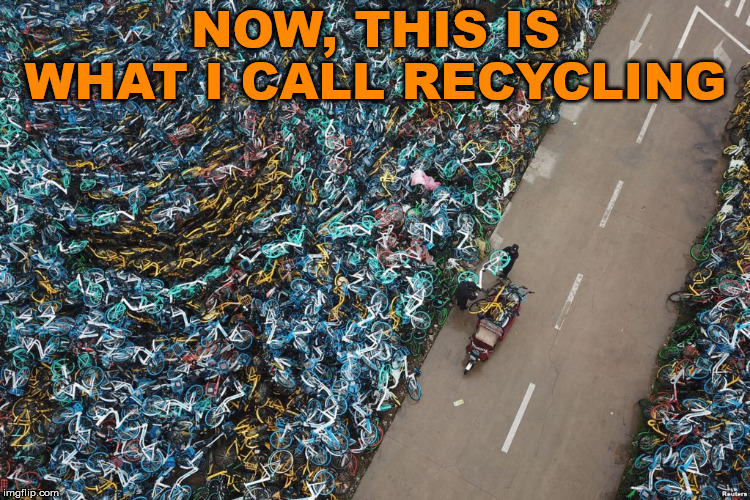
The notion of recycling, once lauded as a heroic stride against the tide of waste, has, under the unrelenting pressure of rampant industrialization and the feverish logic of late-stage capitalism, metamorphosed into a slick, ideological comfort blanket. We term it “recycling,” yet its function often reads less like mending the fabric of our ecological existence and more like applying a patch over a gaping wound – a banal conceit that distracts from the far deeper, more insidious rot gnawing at the roots of our modern predicament.
The Seductive Bandage: An Economy of Illusion
The very premise of recycling panders to an ingrained human desire for rectification, offering a quasi-heroic fantasy of personal efficacy in a system designed for obsolescence. We diligently separate our tins from our greens, meticulously folding paper into tiny cubes, thereby engaging in what might be termed a “quixotic endeavor.” This meticulous sorting feels productive, tangible proof against the overwhelming熵(Entropy) we witness daily. We become, momentarily, the protagonists of a self-contained narrative where individual action battles entropy, conveniently ignoring the fundamental narrative structure that governs our world – a world defined not by balance, but by ceaseless throughput and expansion. The process itself becomes fetishized, a ritualistic dance performed daily with cans and cartons, absorbing ideological significance disproportionate to its environmental impact. It becomes a cognitive shortcut, lulling us into believing that the *system* can be reformed, tamed, and civilized, rather than that the *entire foundation* requires radical transformation. The sheer logistics, the endless sorting, the inherent inefficiency (recyclable materials often require more energy than virgin production), coupled with the paltry, near-imperceptible, reduction in landfill volume it achieves over the long, slow arc of our ecological crisis, only serves to deepen the absurdity. Recycling operates like a fever dream economy, where symbols of consumption are repurposed, but the fever never truly breaks.
Beyond the Bin: The Cracks in the Capitalist Facade
Why must we reach for a Band-Aid before the infection sets in? To answer this requires peeling back the layers of how waste is manufactured, not merely disposed of. Our current economic model, increasingly identified as late-stage or financialized capitalism, operates on principles fundamentally antagonistic to ecological preservation. In this paradigm, the extraction and consumption of resources are the lifeblood, the engine of perpetual growth and profit generation. Waste, in this system, is paradoxically the primary outcome – the intended, necessary consequence of our productive whirlwind. It is not an accidental byproduct; it is a designed endpoint, a monument to the relentless drive for obsolescence. Therefore, the recycling infrastructure currently cobbled together is nothing more than a kluge to manage the mountains of refuse created by this inherent system flaw. It’s a technological placebo, a complex Rube Goldberg machine designed to manage a symptom rooted in the illness itself, subtly reinforcing the belief that waste can be a solved problem, muffled within existing market parameters.
A Necessary Symptom?: Recycling in the Age of Overconsumption
The sheer scale of recycling is, in itself, a potent symbol. The vast, labyrinthine industrial complexes transforming waste materials back into “virgin” polymers; the specialized sorting machinery; the labyrinthine supply chains optimizing collection services – it screams at us: look at all this activity, this tangible effort to convert trash into treasure! This very volume is undeniable evidence of *our need* to recycle, proof of overproduction and overconsumption writ large. Yet this scale introduces its own peril. The infrastructure, built to manage unprecedented waste flows, inherently shapes the waste it must handle. It rewards complexity and quantity, encouraging a “recyclable nightmare,” where items become so engineered with niche recycling mindsets in mind that they become technologically obsolete faster than their simpler counterparts (planned obsolescence repackaged) or encouraging the proliferation of complex packaging designed solely to meet the end-of-life mandate of being “stewardly.” The scale of the collection network inadvertently creates a market for recycled goods, which in turn demands more collection, more sorting, more participation. It fosters a circular narrative that, left unchecked, can become indistinguishable from a linear system dressed in green. It’s a testament to the problem, yet hailed as its elegant solution – a cruel irony bordering on the absurd. We’re told to reduce, reuse, recycle – but the imperative to recycle, fueled by visible infrastructure, becomes the dominant message.
The Illusion of Sustenance: Feeding the Growth Machine
Moreover, recycling, particularly the recycling of complex polymers, metals, and composites, is anything but a zero-impact solution. It is, often, an energy-intensive endeavor, frequently demanding more fossil fuels and chemical processes than necessary for virgin extraction and manufacturing. This inherent contradiction underscores the flawed nature of recycling as a primary environmental strategy. It diverts significant, scarce resources – financial capital and human labor – from truly transformative, regenerative pursuits towards managing the symptoms of a growth-dependent, extractive system. The money spent on sophisticated curbside collection, massive sorting plants, international shipping of commodities, and developing complex recycling technologies could be funneled into, to borrow Marx’s insight, “the expropriation of the expropriators,” or the development of genuinely sustainable, closed-loop, industrial ecology models operating beyond monetary imperatives, or direct investment in regenerative agriculture or de-industrialization strategies. Recycling becomes a form of economic alchemy, transforming toxic detritus into something marginally less harmful, but within the confines of the prevailing market logic, thereby perpetuating a cycle of production and disposal, albeit slightly repackaged.
Deconstructing the Icon: The Problematic Heroism of Recycling
We elevate the recycling warrior – the conscientious shopper, the diligent sorter, the entrepreneur launching a startup using recycled feedstocks – as a paragon of virtue in the environmental landscape. This individual is positioned within the dominant value structure, reinforcing the illusion that sustainable choices are not only available but that the system itself is inherently transformable through individualized effort. This fosters an ecological version of religious hope – tirelessly recycling our current way of life into a slightly greener patch, thereby sidestepping the need for a radical questioning of that lifeboat. This narrative subtly betrays the necessary shift in emphasis: we should champion the *conscious limitation* of consumption, the *rethinking* of needs and wants, and the embrace of sufficiency over infinity, rather than celebrating symbolic reduction. The cultural heroism afforded to the dedicated recycler subtly obscures the primary villain: the system demanding its resources be perpetually consumed until the whole edifice collapses.
The Crucial Question: Whose Waste Burden?
But perhaps the most potent critique lies not merely in recycling’s capacity to obscure systemic flaws, but in its distributional consequences. The burdens of recycling, particularly the hazardous labor and environmental degradation, often rest disproportionately upon the backs and lands of marginalized communities globally and low-income residents nationally – communities forced to bear the stench and health risks of waste processing and contaminated sites, a direct consequence of a rapacious globalist capitalism driven by profit extraction regardless of cost. This uneven application of the recycling mandate reveals capitalism’s inherent tendency towards exploitation, extending even to its attempt to render itself sustainable. The narrative of the “wasteful” versus the “responsible recycler” often masks a deeper political reality, that the game is rigged, that capital requires waste production regardless of individual, often well-intentioned, efforts to manage it. The Band-Aid is patching the hole while keeping everyone on the job.
In summing up these disparate arguments, it becomes clear that recycling, as currently constructed within the crucible of late-stage capitalism, has metastasized. No longer a modest, albeit vital, tool in resource management, it has become an ideological architecture, a vast, complex mechanism to maintain the fantasy of perpetual, linear progress without confronting the fundamental ecological unsustainability built into its foundations. It is, most poignantly, a capitalist Band-Aid – brilliantly, tragically, applying palliative care to an existential hemorrhage. It buys time, yes, but the hemorrhage shows no sign of abating. Perhaps, then, the far more critical task is to accept the Band-Aid’s inadequacy, to cease polishing the grave marker and finally begin excavating a new one.


