Weekends, often celebrated as the sanctuary from the relentless cadence of work, are more than just a pause in the weekly grind. They are the intricate byproduct of societal evolution, a subtle reverberation of economic pragmatism, and a compelling concession by capitalism itself. Like an oasis in a desert of ceaseless labor, weekends serve as a temporal refuge, a rhythmic interlude that balances the imperatives of production with the inherent human need for respite and rejuvenation.
The Birth of the Weekend: From Sacred Time to Economic Strategy
In the tapestry of history, the weekend did not emerge merely as a cultural or religious happenstance but evolved into a deliberate structural fragment within the capitalist architecture. Initially, sacred observances carved out days of rest, sanctified by faith and tradition. However, the rapid incursion of industrialization redefined time itself. The monochrome clock face of the factory whistle transformed labor into regimented units, commodifying human hours as mere cogs in a production machine. Yet, even within this mechanized framework, an intrinsic acknowledgment arose: perpetual toil erodes productivity and engenders unrest.
This realization birthed the weekend as a strategic concession. By intentionally designating a respite—initially just a Sunday—the industrial complex could soothe the working class’s fatigue and foment continued allegiance to the labor system. Over time, this expanded to include Saturday, forming the contemporary two-day weekend. It became a tacit contract: workers surrender continuous labor in exchange for temporal freedom, a breathing space to restore capacity and morale.
Capitalism’s Balancing Act: Productivity Versus Human Vitality
Capitalism thrives on perpetual motion, a relentless surge of output and consumption. Yet, it paradoxically demands the preservation of the very workforce that fuels this engine. The weekend is capitalism’s intricate fulcrum, balancing the imperative for economic expansion against human frailty. Without periodic intervals of rest, the worker slips from asset to liability.
Think of the weekend as the lubrication in a complex gear system. Continuous friction—constant labor without alleviation—would grind the system to a halt. The carefully maintained pause mitigates burnout and sustains long-term efficiency. Ironically, by granting this concession, capitalism ensures its own perpetuity. The weekend, then, is not simply a philanthropic gesture but a tactical gesture to sustain the labor market’s vitality.
Weekends as Temporal Sanctuaries: The Psychology of Rest
Beyond the economic calculus, weekends possess a unique psychological and cultural appeal. They embody a temporal sanctuary where time dilates, allowing individuals the freedom to reclaim agency over their hours. The rigidity of the workweek’s regimented hours—with its punctual start, precision breaks, and mandated end—gives way to a more amorphous rhythm.
This contrast cultivates a psychological space where creativity, relationships, and self-reflection flourish. Weekends become fertile ground for hobbies, familial bonds, and the pursuit of passions that lie dormant during the workweek’s suffocating structure.
The metaphorical gestalt here is compelling: if the workweek is a tightrope, taut and unyielding, the weekend is the tented refuge at either end—flexible, welcoming, and spacious. It exemplifies how temporal design impacts human well-being, underscoring that rest is not merely an absence of labor but an essential domain for mental and emotional regeneration.
The Weekend: A Marker of Social Progress and Inequality
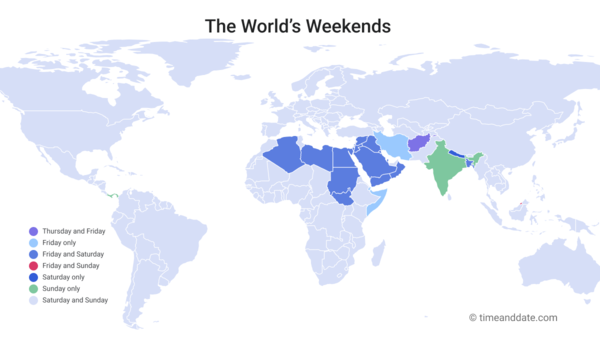
While the weekend is often idealized as a universal right, its historical and global application reveals it as a potent marker of social progress—and simultaneously, social inequality. Early industrial economies adopted weekends unevenly, and even today, disparities in labor rights mean that access to this temporal sanctuary is not a given for all workers.
For many in precarious or informal employment, weekends blur into a continuum demanding constant availability. The weekend thus becomes a prism through which one can examine the uneven distributive justice of rest. Its presence signals a society that values leisure as a component of humanity; its absence exposes economic strata that remain tethered to the drudgery without reprieve.
This duality reflects capitalism’s paradoxical nature—facilitating innovation, efficiency, and wealth generation while simultaneously perpetuating systemic imbalances that restrict who benefits from concessions such as the weekend.
The Cultural Alchemy of Weekend Rituals
The weekend’s distinctive allure is not just its temporal freedom but its capacity to catalyze cultural rituals and social alchemy. Markets bustle with weekend shoppers. Parks swell with families. Sporting events, communal festivities, and artistic engagements cluster within this compressed vial of extra time.
These rituals transform the weekend from a mere cessation of labor into a vibrant social crucible. The weekend activates a collective consciousness that rejoices in liberation from obligations and nurtures communal identity. It is a societal breath, a shared exhale, a time when the pulse of life quickens beyond the monotony of toil.
In this sense, weekends embody an intrinsic human yearning: a cyclical reminder that life is more than production. They gift societies the chance to renegotiate the relationship between labor and leisure, embedding meaning into the flow of time itself.
The Future of Weekends: Flexibility and the Shifting Work Paradigm
The concept of the weekend faces both challenge and transformation in today’s rapidly shifting economic and technological landscape. Remote work, gig economies, and digital connectivity blur the boundaries between weekdays and weekends. The traditional fortress of two days off may splinter into more fluid arrangements, responding to individualized schedules and broader economic flux.
Yet, even amidst these changes, the underlying principle that weekends represent—an intentional delimitation of labor and the preservation of human vitality—remains salient. The weekend’s future may not look like its past, but it will continue to serve as capitalism’s tacit acknowledgment that people are not inexhaustible resources.
Indeed, the weekend endures as both a historical artifact and a living symbol: a delicate truce in the epic struggle between ceaseless production and the human need for rest, reflection, and renewal.

